Greenhouse ventilation system design affects temperature, humidity, air movement and the overall stability of the growing environment. Commercial greenhouses may use natural roof and side ventilation, mechanical exhaust fans or a combination of several systems depending on greenhouse geometry, crop requirements and regional climate conditions.
What Is a Greenhouse Ventilation System?
A greenhouse ventilation system exchanges indoor greenhouse air with outside air and helps remove excess heat and moisture from the production environment.
Depending on the greenhouse structure, ventilation may be provided through roof vents, side openings, motorized windows, exhaust fans or other mechanical airflow equipment.
Ventilation is one part of the wider greenhouse climate control system . Heating, ventilation and environmental measurements should therefore be coordinated rather than operated as completely independent systems.
How Does Greenhouse Ventilation Work?
A ventilation strategy typically begins with climate measurements and ends with controlled movement of air through the greenhouse.
Temperature, humidity and outside conditions are monitored.
The control system determines whether ventilation is required.
Roof vents, side openings or fans are operated as needed.
Climate response and equipment operation are continuously checked.
Natural Ventilation vs Mechanical Ventilation
| Criteria | Natural Ventilation | Mechanical Ventilation |
|---|---|---|
| Air movement | Uses wind and temperature-driven air movement | Uses fans or other powered equipment |
| Energy use | Usually requires less operating energy | Requires electrical energy for fans |
| Control | Performance depends partly on outdoor conditions | Air movement can be controlled more directly |
| Equipment | Roof vents, side vents and motorized openings | Exhaust fans, circulation fans and related equipment |
| Application | Common in properly designed commercial greenhouse structures | Useful where additional airflow or forced ventilation is required |
How Does Natural Greenhouse Ventilation Work?
Natural ventilation relies on differences in air temperature, pressure and wind conditions to move air through greenhouse openings.
Warm air tends to rise toward the upper areas of the greenhouse. Roof ventilation can allow this warmer air to leave while cooler outside air enters through other openings.
The effectiveness of natural ventilation depends on greenhouse geometry, vent arrangement, wind direction, outside temperature and the amount of open ventilation area.
Why Are Roof Vents Important?
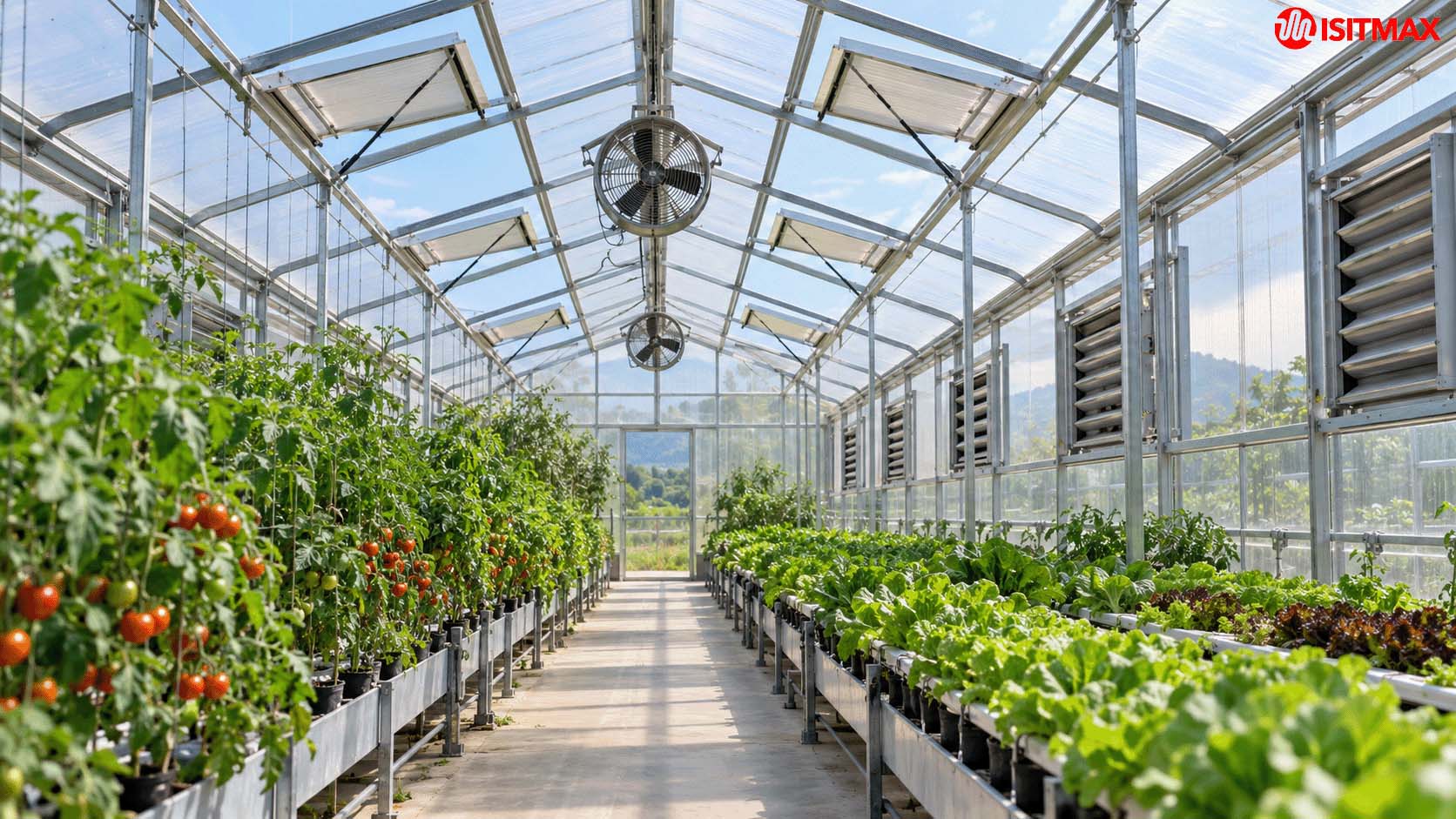
Roof vents are positioned near the upper part of the greenhouse, where warm air naturally accumulates.
Opening roof vents can help release excess heat and moisture while supporting air exchange through the greenhouse.
Vent geometry and opening area should be considered during greenhouse structural design rather than added after construction.
This is one reason why ventilation should be coordinated with greenhouse construction systems during the engineering stage.
What Is Mechanical Greenhouse Ventilation?
Mechanical ventilation uses powered equipment to create or support airflow through the greenhouse.
Exhaust fans can remove warm or humid air, while appropriately designed air inlets allow replacement air to enter the facility.
Mechanical systems can be particularly useful where natural airflow is insufficient or where greenhouse operation requires a more predictable airflow strategy.
Exhaust Fans vs Circulation Fans
Exhaust Fans
Move greenhouse air out of the structure and create controlled air exchange with the outside environment.
Circulation Fans
Move air within the greenhouse to reduce stagnant zones and improve internal air distribution.
Different Functions
Internal circulation and actual ventilation are related but are not the same process.
Integrated Control
Both systems can be controlled according to climate sensors and environmental conditions.
Air circulation inside a greenhouse does not automatically mean that the greenhouse is being ventilated. Circulation fans move internal air, while ventilation exchanges greenhouse air with the outside environment.
How Does Ventilation Affect Greenhouse Temperature?
Solar radiation can cause greenhouse air temperature to rise significantly during the day.
Ventilation allows warmer internal air to be replaced with outside air when environmental conditions allow it.
However, the ability of ventilation to cool a greenhouse depends on the outside temperature. When outside air is also very warm, ventilation alone may not provide sufficient cooling.
In these situations, additional cooling technologies may be required depending on the project and regional climate.
How Does Ventilation Affect Greenhouse Humidity?
Plants release moisture into greenhouse air through transpiration. Irrigation and wet surfaces can also contribute to internal humidity.
Ventilation can remove humid greenhouse air and replace it with outside air when external conditions are suitable.
Humidity management must nevertheless be coordinated with heating. During cold weather, excessive ventilation can increase heating demand and energy consumption.
This interaction is why ventilation should be managed through a broader greenhouse climate-control strategy.
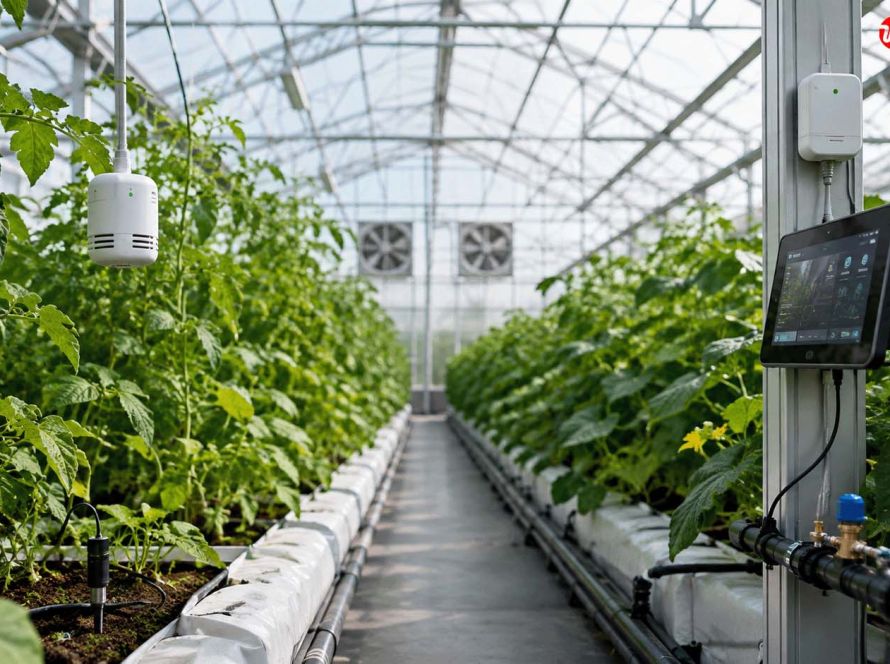
Which Sensors Are Used for Ventilation Automation?
Temperature Sensors
Provide information about heat conditions inside different greenhouse zones.
Humidity Sensors
Help determine whether internal moisture conditions require ventilation or other climate-control actions.
Wind Sensors
Outdoor wind information can be used when controlling motorized roof and side ventilation.
Rain Sensors
Rain information can be included in automatic vent-control strategies where necessary.
Correct measurement also depends on sensor location. See our greenhouse sensor placement guide for more information.
How Is Greenhouse Ventilation Automated?
Greenhouse automation can operate vents and fans according to environmental measurements and predefined control logic.
Climate Conditions Are Measured
Sensors collect greenhouse and outdoor environmental data.
Control Targets Are Evaluated
Temperature, humidity and safety conditions are compared with configured values.
Ventilation Equipment Is Operated
Roof vents, side vents or fans are activated according to the selected strategy.
System Response Is Monitored
Climate values and equipment feedback are continuously checked.
These functions can be integrated with greenhouse automation systems for centralized climate and equipment control.
Why Should Greenhouse Ventilation Be Divided into Zones?
Large greenhouse facilities may experience different conditions between blocks or production areas.
Solar exposure, wind direction, greenhouse orientation, crop density and heating distribution can all create environmental differences.
Dividing the facility into climate zones allows ventilation equipment to respond according to the conditions in each area rather than treating the entire greenhouse as one uniform environment.
Common Greenhouse Ventilation Design Mistakes
Insufficient Vent Area
A greenhouse may have ventilation openings but still lack enough effective opening area for the project conditions.
Ignoring Wind Conditions
External wind affects both natural ventilation performance and the safe operation of motorized vents.
Confusing Circulation with Ventilation
Internal fans alone do not replace the need for appropriate air exchange with the outside environment.
Controlling Heating and Ventilation Separately
Poorly coordinated control can increase energy use or create unstable climate conditions.
Ventilation in Turnkey Greenhouse Projects
Ventilation design is closely related to greenhouse geometry, structure, heating, automation and crop requirements.
Within Agroteknik's turnkey greenhouse projects , ventilation openings, climate sensors, heating infrastructure, automation and other environmental-control systems can be planned within the same engineering process.
This makes it easier to coordinate the greenhouse structure with the systems that will later control the production environment.
Plan Your Greenhouse Ventilation System
We can evaluate roof ventilation, side vents, fans, airflow, climate sensors and automation requirements according to your greenhouse structure, location and production model.