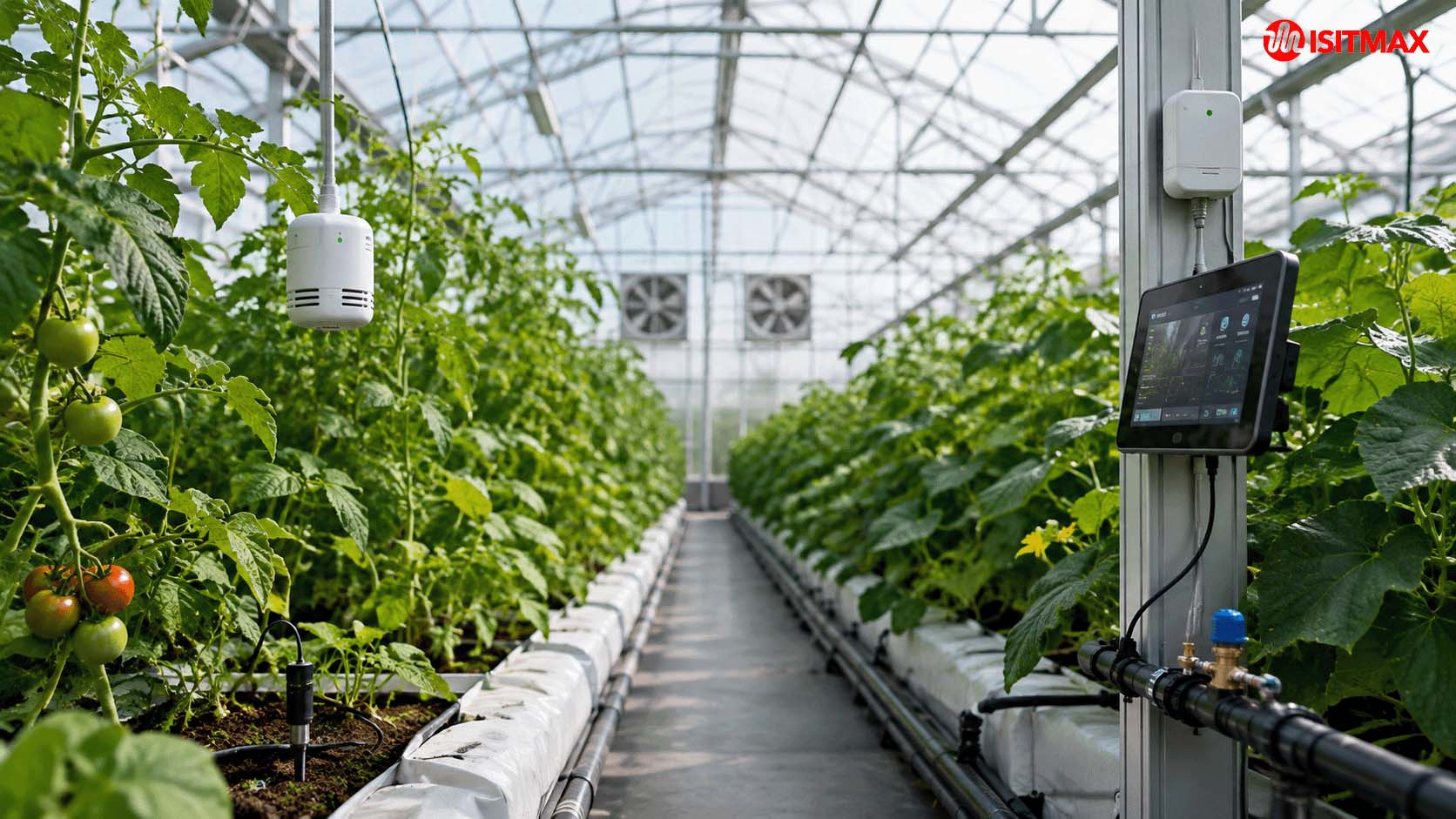
Greenhouse sensor placement is as important as selecting the sensors themselves. A high-quality sensor installed in the wrong location can produce data that does not represent actual crop conditions. Temperature, humidity, CO₂, irrigation and root-zone sensors should therefore be positioned according to greenhouse geometry, crop height, airflow, equipment locations and the control strategy used by the automation system.
Why Is Greenhouse Sensor Placement Important?
Greenhouse automation decisions are based on measured data. Heating, ventilation, irrigation and alarms may all respond to information coming from environmental sensors.
If a sensor is exposed to direct sunlight, positioned too close to a heater or installed in an area with unusual airflow, its measurements may differ significantly from actual crop conditions.
Correct sensor placement is therefore a fundamental part of greenhouse automation system design .
What Should a Greenhouse Sensor Represent?
The main objective is not simply to measure the greenhouse. The objective is to measure the conditions that are relevant to crop production and equipment control.
Measurements should reflect the environment experienced by the crop.
Separate greenhouse blocks may require individual measurement points.
Sensors should correspond with the equipment or area being controlled.
Local heat, drafts and direct radiation should not distort measurements.
Where Should Greenhouse Temperature Sensors Be Installed?
Temperature sensors should normally be positioned where they can represent the thermal conditions surrounding the crop.
Crop height changes during the production cycle, so sensor height may also need to be considered when plants become taller.
Sensors should generally be protected from direct solar radiation and should not be installed immediately beside heaters, hot pipes, ventilation openings or other sources that can create local temperature differences.
Direct Sunlight
Solar radiation can warm the sensor housing and create a temperature reading higher than the surrounding air.
Heating Equipment
Sensors positioned too close to heaters or hot pipes may report locally elevated temperatures.
Vent Openings
Incoming outdoor air can create measurements that do not represent the wider greenhouse zone.
Unrepresentative Corners
Areas with unusual airflow or little crop activity may not represent production conditions.
Where Should Humidity Sensors Be Placed?
Relative humidity sensors are often installed together with temperature sensors because temperature directly affects relative humidity measurements and greenhouse climate interpretation.
Humidity measurements should represent conditions around the crop rather than areas immediately beside irrigation outlets, wet surfaces or ventilation equipment.
Sensor protection and airflow around the measurement element are also important because condensation or persistent direct moisture can affect measurement quality and sensor life.
Temperature and humidity information can then be used by greenhouse climate control automation to coordinate heating and ventilation.
Where Should CO₂ Sensors Be Installed in a Greenhouse?
CO₂ concentration can vary throughout a greenhouse depending on plant activity, air circulation, ventilation and CO₂ distribution systems.
A CO₂ sensor should therefore be placed where it can represent the atmosphere around the crop canopy rather than directly beside a CO₂ supply point or ventilation opening.
In larger facilities, multiple measurement zones may be necessary to understand whether CO₂ is distributed uniformly.
Installing a CO₂ sensor directly beside a dosing outlet may show that the target concentration has been reached even when the rest of the greenhouse has not reached the same condition.
Where Should Root-Zone Sensors Be Installed?
Root-zone measurements provide information about conditions directly surrounding the crop roots.
Depending on the growing system, sensors may monitor root-zone temperature, substrate moisture, electrical conductivity or other production variables.
Sensors should be installed at a representative location within the growing medium rather than at unusual wet or dry points.
Where root temperature is actively controlled, root-zone heating systems can use these measurements as part of the control strategy.
Where Should Irrigation Sensors Be Installed?
Irrigation monitoring may involve flow meters, pressure sensors, EC and pH sensors, tank-level sensors and other measurement devices.
| Sensor | Typical Measurement Point |
|---|---|
| Flow meter | Main irrigation line or individual irrigation zones |
| Pressure sensor | Locations used to verify hydraulic system performance |
| EC sensor | Prepared nutrient solution or selected irrigation line |
| pH sensor | Nutrient preparation and control section |
| Tank-level sensor | Water, fertilizer or nutrient solution tanks |
These measurements can be integrated with greenhouse fertigation automation for dosing, irrigation and alarm control.
How Many Sensors Does a Greenhouse Need?
There is no universal number of sensors that applies to every greenhouse. The correct number depends on greenhouse size, geometry, production zones and the amount of environmental variation across the facility.
A small and relatively uniform greenhouse may require fewer measurement points than a large multi-span commercial facility.
The objective should be to install enough sensors to detect meaningful differences without adding unnecessary measurement points that provide little additional information.
Why Do Large Greenhouses Need Multiple Sensor Zones?
Conditions inside a large greenhouse are rarely identical everywhere.
Solar exposure, ventilation, heating distribution, crop density, greenhouse orientation and external weather can create different temperature and humidity conditions between areas.
Different Greenhouse Blocks
Separate spans or blocks may have different thermal and ventilation characteristics.
Different Crops
Production areas containing different crops may require different environmental targets.
Different Equipment
Heating, ventilation and irrigation equipment may not affect every greenhouse area equally.
Different Exposure
External walls and greenhouse edges may experience different conditions from central production zones.
Should Sensors Be Installed at Different Heights?
In some greenhouse and indoor production systems, vertical temperature and humidity differences can develop.
Measuring conditions at different heights can be useful when evaluating tall crops, stacked production areas or facilities where air circulation is not uniform.
This is particularly important in vertical farming rack systems , where multiple growing levels may experience different environmental conditions.
How Often Should Greenhouse Sensors Send Data?
Measurement frequency should match the speed at which the monitored variable changes and the purpose of the data.
Fast-changing control variables may require more frequent updates, while slower analytical measurements may not need the same reporting rate.
Sending data unnecessarily often can increase network traffic, database size and power consumption in battery-powered wireless devices.
The sampling interval and data-transmission interval can also be different. A device may measure frequently while sending summarized or grouped data at a different interval.
Wired or Wireless Sensors for Greenhouses?
| Criteria | Wired Sensors | Wireless Sensors |
|---|---|---|
| Communication | Uses physical cabling | Uses a wireless network or IoT protocol |
| Power | Can often share wired power infrastructure | May require batteries or local power |
| Installation | Requires cable routing | Can simplify installation in suitable areas |
| Maintenance | Fewer battery-related maintenance requirements | Battery and signal quality may require monitoring |
| Expansion | May require additional wiring | Can simplify adding new measurement points |
The correct communication method depends on greenhouse size, infrastructure, required reliability and maintenance strategy.
Sensor Calibration and Maintenance
Correct placement alone does not guarantee reliable greenhouse data. Sensors can drift over time or become affected by dust, moisture, fertilizer residues and greenhouse operating conditions.
Inspect Sensors Regularly
Check for physical damage, contamination and abnormal readings.
Calibrate When Required
EC, pH and other measurement devices should follow suitable calibration procedures.
Compare Similar Sensors
Unexpected differences between nearby sensors can help identify measurement problems.
Monitor Communication
Missing data and communication failures should generate technical alarms where appropriate.
Common Greenhouse Sensor Placement Mistakes
Installing Sensors in Direct Sunlight
Radiation can distort temperature measurements and produce misleading climate data.
Installing Sensors Too Close to Equipment
Heaters, fans, vents and irrigation equipment can create highly localized conditions.
Using One Sensor for a Large Greenhouse
A single measurement point may hide important differences between production zones.
Ignoring Sensor Height
Measurements taken far above or below the crop may not represent the production environment.
How Are Greenhouse Sensors Connected to IoT Systems?
Sensors can communicate with local controllers, gateways or other field devices using wired or wireless communication methods.
A gateway can collect data from multiple greenhouse measurement points and transfer it to a centralized server or cloud platform.
Agroteknik's greenhouse IoT infrastructure can combine sensor data, alarms and equipment status within a centralized monitoring architecture.
Historical measurements can also be stored through a cloud-based greenhouse management platform for remote monitoring and analysis.
How Can Sensor Data Be Used for Smart Greenhouse Management?
Sensor data becomes more valuable when it is not used only for displaying current values.
Historical greenhouse measurements can be used to compare different production periods, identify recurring climate deviations and evaluate relationships between environmental conditions and equipment operation.
These datasets can also provide the foundation for more advanced analytics and artificial intelligence and machine-learning applications .
Sensor Planning in Turnkey Greenhouse Projects
Sensor locations are easier to design when measurement requirements are considered before the greenhouse automation installation begins.
Within Agroteknik's turnkey greenhouse projects, climate zones, sensor locations, wiring, gateways, controllers, alarms and cloud infrastructure can be planned as parts of the same technical architecture.
This makes it possible to coordinate the physical greenhouse layout with the data infrastructure required for monitoring and automation.
Plan Your Greenhouse Sensor Infrastructure
We can evaluate sensor types, measurement locations, climate zones, IoT communication, automation, alarms and remote monitoring requirements according to your greenhouse project.