Vertical farming rack design directly affects growing capacity, lighting performance, airflow, irrigation, worker access and operating cost. Adding more growing levels does not automatically create a better vertical farm. Rack height, spacing between levels, aisle width, crop dimensions and technical equipment should be designed together as part of the complete production system.
What Is a Vertical Farming Rack System?
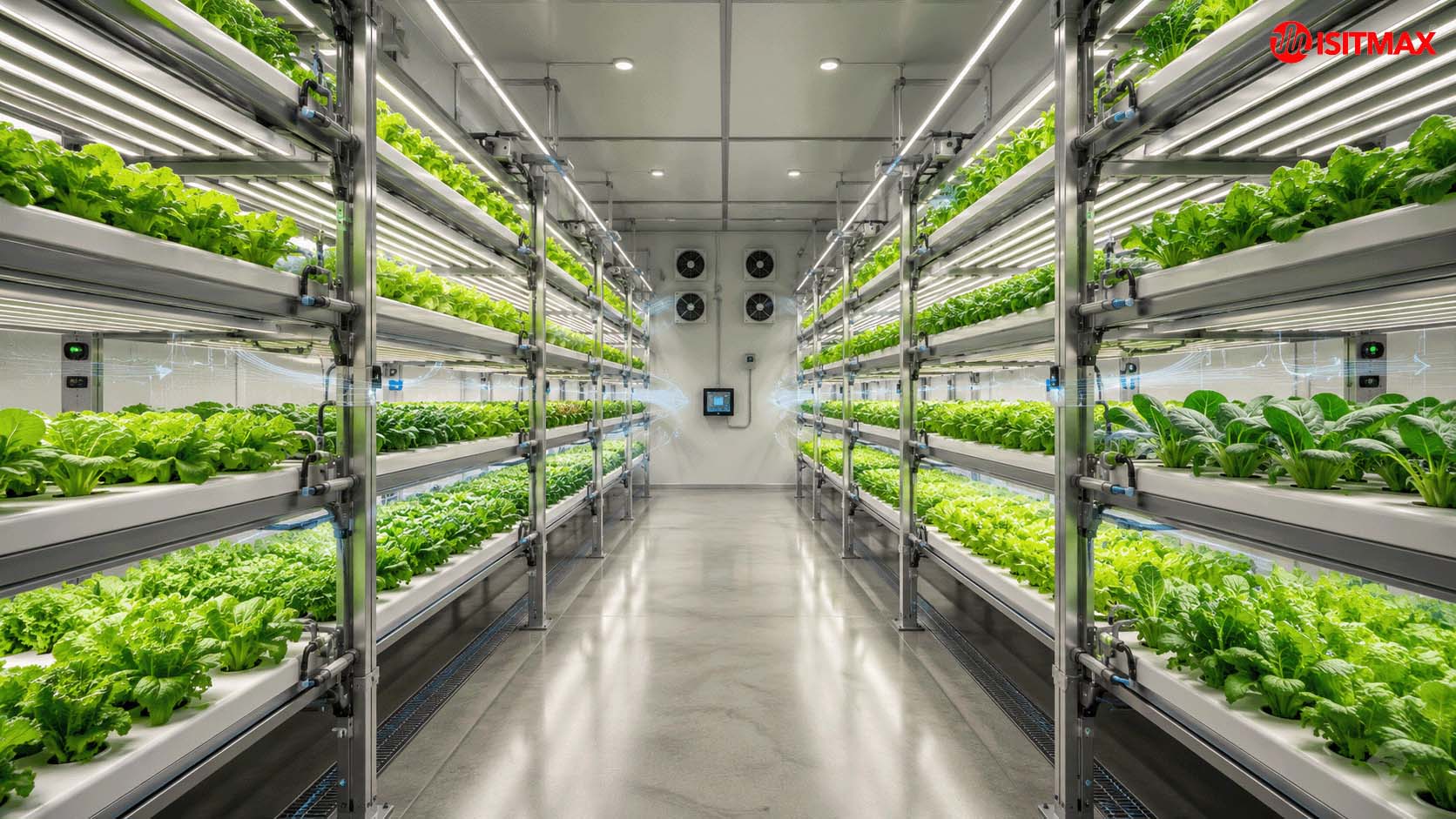
A vertical farming rack system is a multi-level structural framework used to create several growing surfaces within the same floor area.
Each level can contain growing channels, trays or hydroponic systems, together with lighting, irrigation pipes, sensors and other technical components.
The purpose of the rack is not simply to hold plants. It must also provide sufficient access for crop growth, maintenance, harvesting, irrigation infrastructure and environmental control.
What Determines Vertical Farming Rack Layout?
A practical rack layout should be developed around the crop and the operating requirements of the facility rather than simply maximizing the number of shelves.
Plant height, growth habit and harvesting requirements define usable space.
Fixture dimensions, distance to plants and heat generation affect spacing.
Pipes, drains, pumps and growing channels require installation space.
Workers need sufficient room for maintenance, inspection and harvesting.
How Much Space Should Be Left Between Vertical Farming Levels?
There is no universal spacing that is correct for every vertical farm. The required distance between levels depends primarily on crop height, lighting equipment, airflow and maintenance access.
The usable vertical distance should include not only the plant itself, but also the lighting fixture, irrigation components and enough clearance for normal crop development.
Reducing spacing may increase the number of growing levels, but excessive compression can create poor airflow, uneven lighting, difficult maintenance and restricted crop growth.
How Many Levels Should a Vertical Farm Have?
The ideal number of growing levels depends on facility height and the space required by each production layer.
More levels increase active growing area but also increase the amount of lighting, irrigation infrastructure, electrical distribution and equipment that must be installed.
For this reason, the correct number of levels should be based on production economics rather than maximum theoretical capacity.
Facility Height
Available vertical clearance sets the physical limit for the rack system.
Crop Height
Taller crops require more space between growing levels.
Energy Cost
Every additional level usually adds lighting and other electrical loads.
Operational Access
Production capacity is not useful if workers cannot maintain or harvest efficiently.
How Wide Should Aisles Be in a Vertical Farm?
Aisle width should allow safe movement of workers and any carts, harvesting equipment or maintenance tools used in the facility.
Designing aisles too narrowly may increase theoretical growing area but reduce operational efficiency and make routine maintenance more difficult.
Aisle requirements should therefore be evaluated according to worker movement, equipment dimensions, emergency access and the maintenance requirements of the rack system.
The best vertical farm layout is not the layout with the smallest aisles. It is the layout that balances active growing area with practical access, maintenance and safe operation.
How Should Lighting Be Integrated into Vertical Farming Racks?
In stacked growing systems, lighting is usually installed directly above each production level.
Rack design should therefore consider fixture width, installation height, electrical cabling, cooling requirements and the distance between the light source and the crop canopy.
If fixtures are positioned too close to plants, light and heat distribution may become uneven. If they are placed too far away, usable light intensity may decrease.
Lighting layout and rack spacing should always be designed together, because changing one can directly affect the other.
How Is Irrigation Integrated into Vertical Farming Racks?
Multi-level production systems require irrigation water to be delivered consistently across several heights and growing zones.
Depending on the production method, racks may include irrigation supply pipes, return lines, drainage channels, growing gutters and distribution valves.
Hydraulic design should consider pressure losses, flow requirements, drainage and the number of irrigation zones.
Where automated nutrient dosing is used, greenhouse fertigation automation can be integrated with the vertical farming irrigation infrastructure.
Why Is Airflow Important Between Rack Levels?
Dense rack layouts can restrict air movement around the crop.
Poor airflow may create differences in temperature and humidity between growing levels, particularly in facilities with many stacked production layers.
Rack spacing, crop density and air-circulation equipment should therefore be considered as parts of the same climate-control strategy.
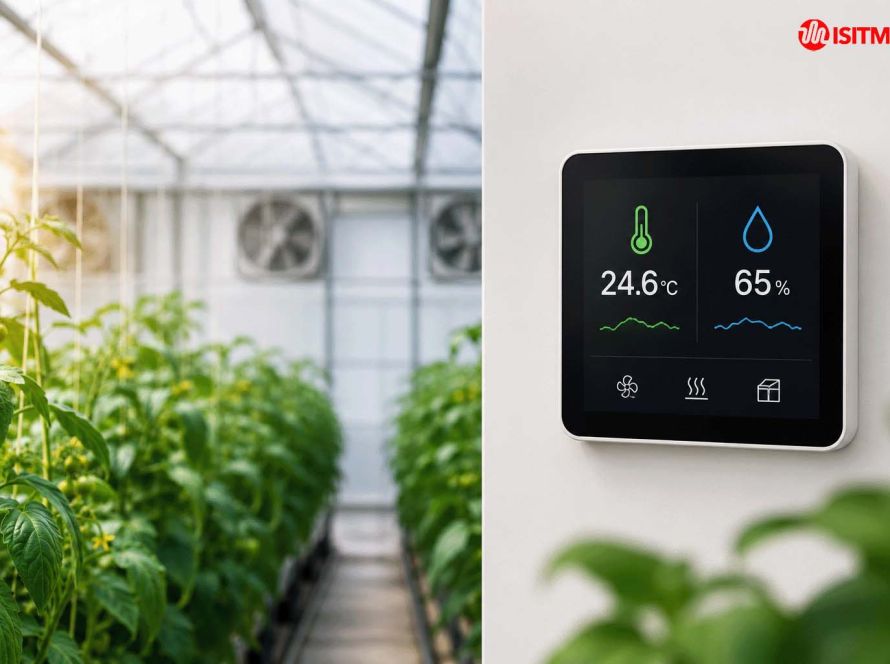
Environmental sensors may also be installed at different heights to determine whether upper and lower rack levels experience different conditions.
Fixed vs Mobile Vertical Farming Racks
| Criteria | Fixed Racks | Mobile Racks |
|---|---|---|
| Layout | Permanent aisle arrangement | Racks may move to create temporary access aisles |
| Complexity | Generally simpler | Requires additional mechanical systems |
| Access | Continuous access to each aisle | Access depends on rack movement strategy |
| Space utilization | Some floor area remains permanently allocated to aisles | Can increase growing-area utilization in suitable projects |
| Investment | Typically lower structural complexity | Can require higher initial investment and maintenance |
What Should Be Considered in Vertical Farming Rack Structures?
Structural Load
Racks must support crops, growing channels, water, lighting and technical equipment safely.
Corrosion Resistance
High humidity and irrigation conditions should be considered when selecting structural materials.
Maintenance Access
Pumps, lights, pipes and sensors should remain accessible after the rack system is fully installed.
Future Expansion
Additional growing levels or rack rows should be considered where future production expansion is expected.
Automation and IoT in Vertical Farming Rack Systems
As the number of growing levels increases, manually monitoring every production zone becomes more difficult.
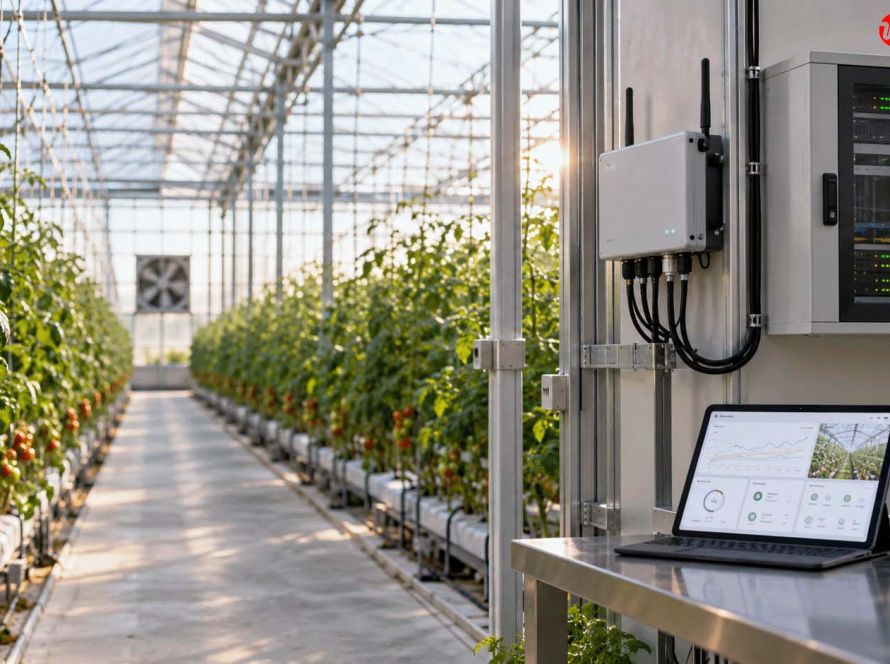
Sensors can monitor temperature, humidity, irrigation, lighting, energy consumption and equipment status across different rack levels.
Agroteknik's greenhouse automation and IoT infrastructure can connect these devices to centralized control and monitoring systems.
Historical operating data can also be stored through a cloud-based management platform for remote monitoring and performance analysis.
Common Vertical Farming Rack Design Mistakes
Maximizing Levels Without Considering the Crop
Too many levels can reduce usable growing height and create poor production conditions.
Designing Lighting After the Racks
Lighting dimensions and mounting distance should influence rack spacing from the beginning.
Ignoring Worker Access
Narrow aisles and inaccessible equipment can increase daily operating effort.
Ignoring Water and Drainage Loads
Growing channels and irrigation systems can add significant weight to the rack structure.
How Should a Vertical Farming Project Be Planned?
Rack design should be developed together with lighting, irrigation, climate control, automation and electrical infrastructure.
The correct process begins with the crop and target production capacity, followed by rack geometry, growing level spacing, aisle arrangement, lighting loads, irrigation infrastructure and automation requirements.
Agroteknik can evaluate vertical farming layouts together with automation, IoT, irrigation and technical infrastructure to develop an integrated production system.
Plan Your Vertical Farming Rack System
We can evaluate rack layout, growing levels, aisle spacing, irrigation, lighting, climate control and automation requirements according to your facility and target crop.