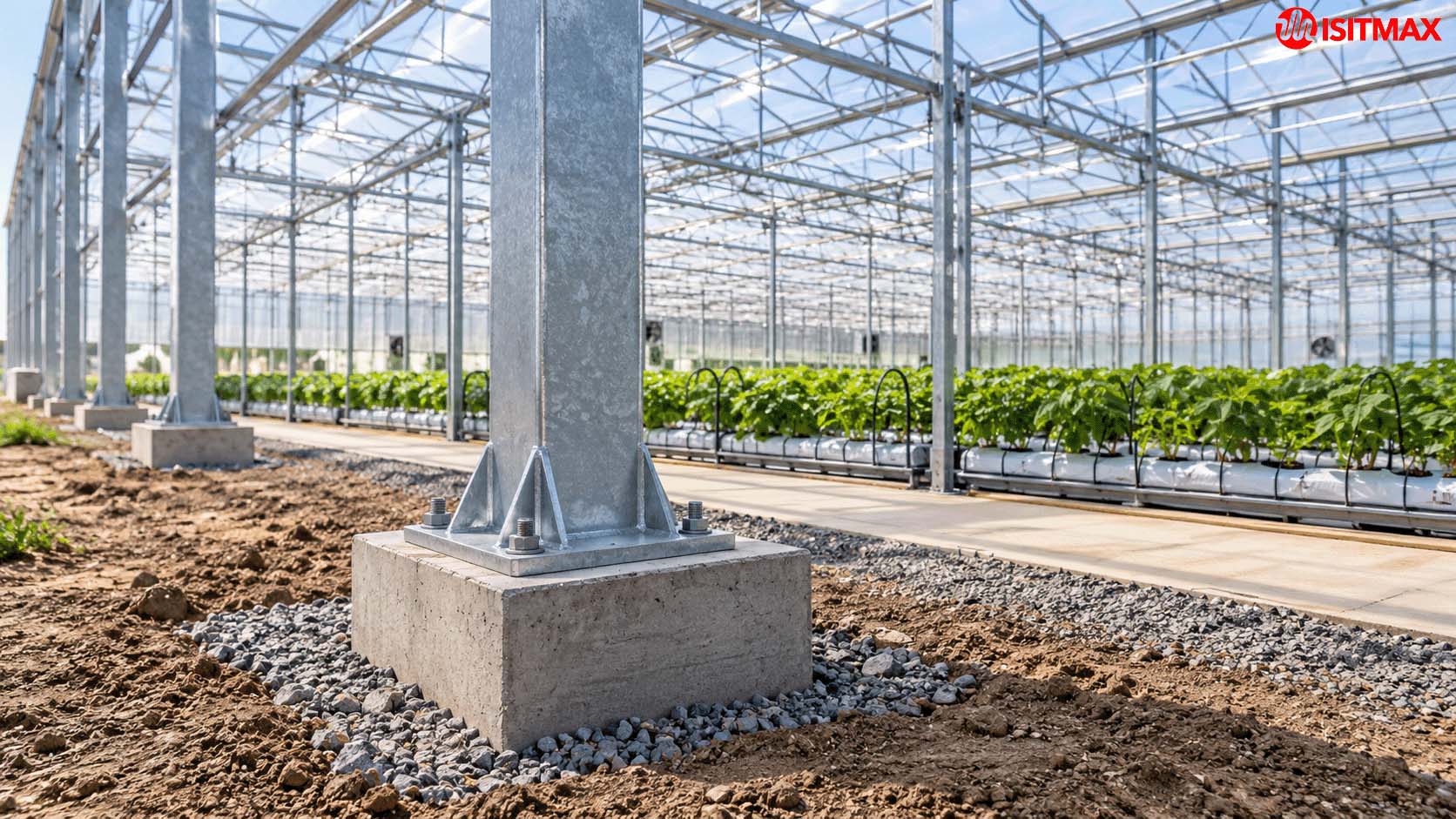
A commercial greenhouse foundation transfers the forces generated by the greenhouse structure into the ground. Foundation design must therefore consider soil conditions, greenhouse geometry, wind uplift, horizontal forces, snow loads, anchoring requirements and site drainage as part of the complete structural system.
What Is a Greenhouse Foundation?
A greenhouse foundation forms the structural connection between the greenhouse frame and the ground.
Its purpose is not limited to carrying vertical weight. Depending on the project, foundations and anchors may also resist uplift, horizontal shear and overturning forces generated by wind and other structural actions.
This is why greenhouse foundations should be designed together with the greenhouse structural system rather than treated as a separate installation detail.
Which Loads Reach the Greenhouse Foundation?
Loads acting on the greenhouse frame eventually create reactions at the points where the structure connects to the ground.
Structural weight, equipment and snow can create downward reactions.
Roof suction can create forces attempting to lift the structure.
Wind creates lateral forces that must be transferred into the ground.
Combined structural forces can create moments at foundation points.
Why Is Wind Uplift Important for Greenhouse Foundations?
Wind does not act only as a horizontal force against greenhouse walls. Airflow around the roof can create suction that produces upward forces.
Open doors, vents or other large openings can also influence internal pressure during severe wind conditions.
These effects can increase uplift demand on columns, base connections and foundation anchors. Greenhouses therefore require adequate anchoring between the superstructure and the ground.
Wind and snow loads from the greenhouse superstructure ultimately create working loads that must be considered by the foundation system.
How Do Soil Conditions Affect Foundation Design?
The same greenhouse structure may require different foundation solutions on different sites.
Soil strength, settlement characteristics, groundwater conditions, fill materials and drainage can affect the type and dimensions of the foundation.
A foundation concept should therefore not be selected only from greenhouse dimensions. Site-specific ground conditions also need to be considered.
For larger commercial projects, geotechnical information can provide important design inputs for structural engineers.
What Types of Greenhouse Foundations Are Used?
Concrete Footings
Individual concrete foundations can be constructed beneath columns or structural support points.
Continuous Foundations
Continuous concrete elements may be used along greenhouse walls or structural lines where required by the project.
Embedded Posts
Certain greenhouse systems use columns or foundation posts embedded into the ground according to an engineered detail.
Ground Anchors
Engineered anchors may be used to transfer uplift and other forces into suitable ground conditions.
There is no universal greenhouse foundation detail that is suitable for every project. Greenhouse geometry, structural reactions, soil, wind, snow, groundwater and local construction requirements should be evaluated together.
Concrete Foundation or Ground Anchor?
| Criteria | Concrete Foundation | Ground Anchor / Embedded System |
|---|---|---|
| Structural principle | Transfers reactions through a concrete footing or foundation element | Transfers forces through embedded or anchored ground connections |
| Construction | Requires excavation, reinforcement or concrete works depending on design | Installation method depends on anchor and soil conditions |
| Site dependency | Dimensions depend on loads and ground conditions | Capacity is strongly dependent on anchor type and soil properties |
| Selection | Should be determined from structural requirements, ground conditions and the complete greenhouse design | |
Why Are Greenhouse Anchors Important?
Anchors create the connection that allows structural loads to move from columns or base plates into the foundation or ground.
If this connection is inadequate, a strong frame alone cannot provide complete structural stability.
Wind-induced uplift is particularly important because it acts in the opposite direction to normal gravity loads.
Anchor quantity, spacing, embedment and connection detail therefore need to reflect the reactions generated by the greenhouse structure.
How Do Wind and Snow Loads Affect Foundation Size?
Wind and snow do not act only on the roof members. Their effects are transferred through columns, bracing and connections until they reach the foundations.
Wind can produce combinations of horizontal load and uplift, while snow generally increases downward loading on the structure.
The final foundation reactions depend on greenhouse geometry, structural system, loading combinations and local design conditions.
For this reason, foundation dimensions should be based on structural reactions rather than selected independently from the greenhouse frame.
Why Is Drainage Important Around Greenhouse Foundations?
Water management around the greenhouse is an important part of site preparation.
Roof runoff, irrigation drainage and stormwater should not create persistent water accumulation around structural foundations.
Poor drainage can affect site access, soil conditions and long-term foundation surroundings.
Ground elevations and drainage routes should therefore be considered before foundation construction begins.
Why Is Foundation Alignment Important?
Commercial greenhouses contain repeated structural bays and long rows of columns. Small positioning errors can accumulate over the length of the greenhouse.
Foundation points, anchors and column interfaces must therefore be installed according to the structural grid and required tolerances.
Incorrect positioning can create problems during frame assembly, gutter alignment, covering installation and door or vent installation.
Greenhouse Foundation Design Process
Define the Greenhouse Structure
Geometry, column locations, structural system and equipment loads are established.
Evaluate Site Conditions
Soil, terrain, drainage and project location are reviewed.
Calculate Structural Reactions
Wind, snow, dead load and other actions are translated into foundation forces.
Design Foundations and Anchors
The foundation system is selected and sized according to loads and ground conditions.
Verify Installation
Position, elevation and anchoring details are checked before greenhouse erection proceeds.
Common Greenhouse Foundation Design Mistakes
Using a Standard Detail Everywhere
A foundation detail from another project may not suit the local soil or structural loads.
Ignoring Wind Uplift
Considering only downward loads can underestimate anchoring requirements during severe wind.
Ignoring Drainage
Site water problems can affect the foundation surroundings and greenhouse operation.
Poor Anchor Alignment
Incorrect anchor positions can create significant problems during structural erection.
Foundation Design in Turnkey Greenhouse Projects
Greenhouse foundation design should be coordinated with structural geometry, wind and snow calculations, site grading and installation.
Within Agroteknik's turnkey greenhouse projects , the greenhouse structure, foundation interfaces, anchoring and site requirements can be evaluated within the same engineering process.
This helps reduce conflicts between foundation construction and greenhouse erection while keeping structural load paths consistent from the roof to the ground.
Plan Your Greenhouse Foundation and Structure
We can evaluate greenhouse geometry, structural loads, anchoring, foundation interfaces and site conditions as part of your commercial greenhouse project.