A well-designed greenhouse irrigation system delivers the required amount of water to the crop with consistent pressure and distribution while minimizing unnecessary water use. Commercial greenhouse irrigation can combine drip lines, emitters, filtration, pressure regulation, storage, sensors and automated control according to crop type and production system.
What Is a Greenhouse Irrigation System?
A greenhouse irrigation system distributes water to plants through a controlled network of pipes, valves and application equipment.
Depending on the crop and growing system, water may be delivered through drip emitters, drip lines, overhead sprinklers, irrigation booms, misting systems or recirculating systems.
In commercial production, irrigation should be designed together with crop layout, water quality, greenhouse zoning and greenhouse fertigation automation .
How Does a Greenhouse Irrigation System Work?
Water normally moves through several stages before reaching the crop.
Water is supplied from a tank, well, mains connection or another source.
Filtration and pressure regulation prepare water for distribution.
Main lines and laterals deliver water to irrigation zones.
Emitters or other devices deliver water to the crop.
Which Irrigation Methods Are Used in Greenhouses?
Drip Irrigation
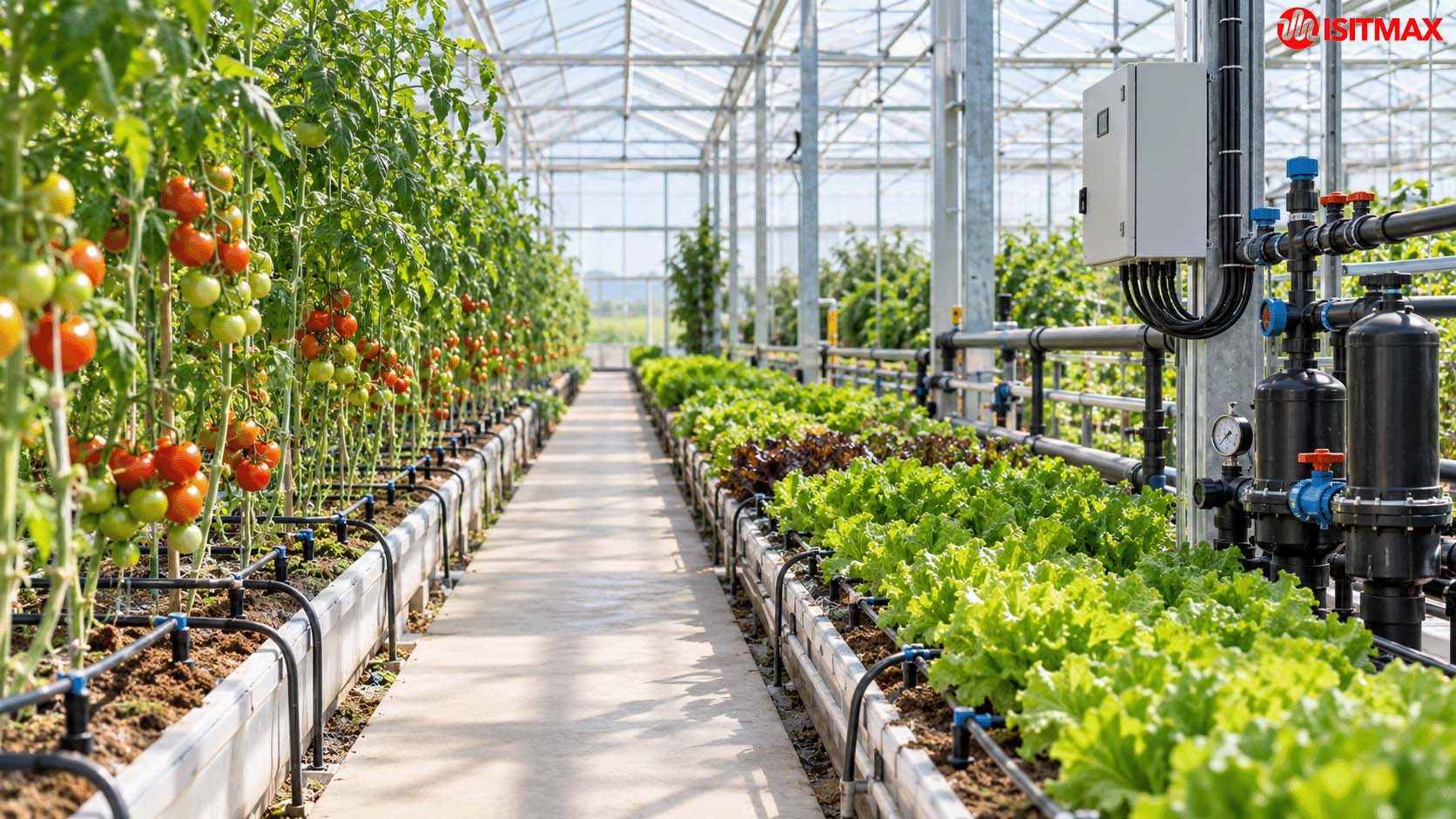
Water is applied directly to individual plants or root zones through emitters or drip lines.
Overhead Irrigation
Water is applied above the crop using sprinklers or nozzles where the production system is suitable.
Irrigation Booms
Moving booms can provide controlled watering over benches or defined greenhouse production areas.
Ebb-and-Flow Systems
Benches or floors are temporarily flooded and the remaining solution can be collected for suitable reuse strategies.
Why Is Drip Irrigation Common in Commercial Greenhouses?
Drip irrigation allows water to be delivered close to the crop root zone instead of wetting the entire greenhouse floor or canopy.
Individual emitters also make it possible to divide production into irrigation zones and apply different irrigation schedules where required.
Drip systems can be automated and integrated with fertilizer dosing, making them especially suitable for many greenhouse vegetable and substrate-based production systems.
However, performance depends on correct hydraulic design, filtration and emitter maintenance. Small emitter passages are vulnerable to clogging when water quality or filtration is inadequate.
What Are the Main Components of a Greenhouse Drip Irrigation System?
Pump and Water Supply
Provide the flow and pressure required by the irrigation network.
Filtration
Removes particles that could block emitters and reduce irrigation uniformity.
Pressure Regulation
Maintains suitable operating pressure across irrigation zones.
Valves and Zones
Allow different greenhouse areas to be irrigated independently.
Drip Lines and Emitters
Deliver water from the distribution network directly to plants.
Control System
Operates irrigation according to time, sensor data or defined production logic.
A greenhouse drip system should not be designed only by selecting an emitter flow rate. Pipe dimensions, operating pressure, zone size, pressure losses, filtration and the number of active emitters all affect irrigation uniformity.
Why Is Irrigation Uniformity Important?
Plants within the same production zone should receive predictable and reasonably uniform irrigation.
Large differences in emitter flow can cause some plants to receive excessive water while others receive less than required.
Pressure variation, clogged emitters, unsuitable pipe dimensions and excessive line lengths can all reduce distribution uniformity.
Pressure-compensating emitters can help improve uniformity in appropriate applications, but the entire hydraulic system still needs to be correctly designed.
Why Is Filtration Important in Greenhouse Irrigation?
Drip emitters contain relatively small water passages. Suspended particles, biological growth or mineral deposits can therefore restrict flow or completely block an emitter.
The appropriate filter depends on water source, emitter specification and expected contaminants.
Pressure gauges and flow measurements can also help identify abnormal system behavior before major irrigation differences develop.
Irrigation laterals should be inspected and flushed according to system requirements as part of preventive maintenance.
How Should Greenhouse Irrigation Be Divided into Zones?
Not every plant inside a greenhouse necessarily requires the same irrigation schedule.
Crop type, plant age, substrate volume, solar exposure and production stage can create different water requirements.
Separate irrigation zones allow valves to operate different areas independently and make irrigation scheduling more flexible.
Large projects may also use separate zones to keep required flow rates and pipe pressure losses within appropriate limits.
Which Sensors Can Be Used for Greenhouse Irrigation?
Substrate Moisture
Provides information about moisture conditions in the root-zone medium.
Flow Meter
Measures irrigation flow and can help identify unexpected changes or failures.
Pressure Sensor
Monitors hydraulic pressure at important points in the irrigation system.
Drain Measurement
In suitable production systems, drainage quantity can provide useful information about irrigation behavior.
Sensor accuracy depends on suitable installation and representative measurement points. See our greenhouse sensor placement guide for more information.
How Does Automatic Greenhouse Irrigation Work?
Automatic irrigation replaces repeated manual valve operation with a controller that manages irrigation zones according to configured logic.
Conditions Are Monitored
Time schedules, moisture data or other production inputs are evaluated.
Irrigation Demand Is Determined
The controller decides whether a zone requires irrigation.
Valve Is Activated
The selected irrigation zone receives water for the configured cycle.
System Is Verified
Flow, pressure or other feedback can be monitored to confirm operation.
Automated irrigation can improve consistency and reduce repetitive manual watering work.
How Are EC and pH Used in Greenhouse Irrigation?
Water quality has an important role in irrigation and nutrient management. Electrical conductivity, or EC, provides information related to the concentration of dissolved salts, while pH describes acidity or alkalinity.
Water-quality evaluation should not rely on pH alone. Alkalinity, hardness and EC may also be important depending on the water source and production system.
In fertigation systems, EC and pH can also be monitored during nutrient preparation and irrigation control.
For fertilizer dosing and nutrient-control details, see our greenhouse fertigation automation guide .
Common Greenhouse Irrigation Design Mistakes
Insufficient Filtration
Poor filtration can lead to emitter clogging and uneven water distribution.
Incorrect Pipe Sizing
Excessive pressure loss can create large differences between irrigation points.
Using One Schedule for Every Zone
Crops and production areas with different conditions may require separate irrigation strategies.
No Flow or Pressure Monitoring
Failures can remain unnoticed when the system has no way to verify actual hydraulic operation.
How Can Water Use Be Reduced in Greenhouses?
Water efficiency begins with delivering irrigation to the intended crop area rather than unnecessarily watering aisles, walls or unused surfaces.
Correct zoning, leak repair, irrigation uniformity and suitable scheduling can all reduce waste.
Depending on the production method, collected drainage water may also be considered for treatment and reuse where technically and agronomically appropriate.
Uniform system design and avoiding unnecessary watering are key parts of efficient greenhouse irrigation management.
Irrigation Systems in Turnkey Greenhouse Projects
Irrigation design is closely connected to crop layout, water source, fertigation, automation and greenhouse infrastructure.
Within Agroteknik's turnkey greenhouse projects , irrigation zones, filtration, pumps, distribution lines, fertigation, sensors and control infrastructure can be planned within the same engineering process.
This allows irrigation capacity and automation requirements to be coordinated with the greenhouse layout from the beginning of the project.
Plan Your Greenhouse Irrigation System
We can evaluate water supply, drip irrigation, filtration, irrigation zones, fertigation, sensors and automation according to your greenhouse structure and production model.