Greenhouse construction involves much more than assembling a steel structure on site. Land conditions, greenhouse type, structural design, covering, heating, irrigation, climate control, automation and commissioning all need to be planned in the correct order. This guide explains the main stages of commercial greenhouse construction, the factors that influence cost and the technical decisions that should be considered before installation begins.
How Is a Greenhouse Built?
A professional greenhouse project begins by defining the intended production model. The crop, project location, production period, local climate and required capacity influence many of the technical decisions made during design.
Land conditions, greenhouse dimensions, structural system, ventilation, irrigation, heating, electrical infrastructure and automation are then engineered according to these requirements.
For projects where all of these systems need to be designed, installed and coordinated within a single scope, turnkey greenhouse systems can be evaluated separately.
What Are the Main Greenhouse Construction Stages?
A commercial greenhouse project can generally be divided into four main stages.
Crop, capacity, location and technical requirements are defined.
Structure, climate, irrigation and technical systems are designed.
Structural and technical infrastructure is installed on site.
Systems are tested, adjusted and prepared for operation.
1. Site and Location Analysis
Before greenhouse construction begins, the site should be evaluated not only according to available area but also according to its suitability for agricultural production.
Solar exposure, prevailing wind direction, land slope, drainage, water availability, electrical infrastructure and site access can all influence project decisions.
Solar Exposure
Surrounding buildings, terrain and orientation can affect the amount of sunlight reaching the greenhouse.
Wind Conditions
Regional wind conditions should be included in the structural engineering of the greenhouse.
Water Supply
Both water capacity and water quality are important when selecting the irrigation and growing system.
Energy Infrastructure
Pumps, automation, lighting and other technical equipment may require significant electrical capacity.
2. Selecting the Crop and Production System
Greenhouse design should not be separated from crop selection. Tomatoes, peppers, strawberries, lettuce and other crops can have different requirements for greenhouse height, crop support, irrigation, climate control and working areas.
Soil-based production, hydroponic systems and other growing methods can also require different technical infrastructure.
These decisions should be made early because they influence the greenhouse structure and nearly every system installed later.
3. How Are Greenhouse Dimensions and Layout Determined?
Greenhouse width, length and height should not be selected only according to the available land area.
Internal logistics, crop rows, service aisles, irrigation systems, technical rooms and possible future expansion should also be included in the layout.
In multi-block commercial facilities, movement between greenhouse sections, crop transport routes and service areas can have a direct effect on daily operating efficiency.
4. How Is the Greenhouse Structure Selected?
The greenhouse structure is the main load-bearing system that supports the covering and installed technical equipment.
Profile dimensions, column spacing and connection systems should be evaluated according to local wind and snow conditions rather than only greenhouse size.
For additional information about modular structural systems, see our weldless greenhouse construction guide.
Two greenhouses with identical dimensions may require different structural solutions when they are installed in locations with different wind or snow conditions.
5. How Is the Greenhouse Covering Selected?
The greenhouse covering has a direct effect on light transmission, internal temperature and energy performance.
Plastic film, polycarbonate and glass can be considered depending on project requirements.
| Criteria | Why It Matters |
|---|---|
| Light transmission | Affects how much natural light reaches the crop |
| Thermal performance | Influences greenhouse heat loss during cold periods |
| Durability | Affects performance under wind, rain and site conditions |
| Maintenance | Influences long-term operation and replacement requirements |
| Initial investment | Can represent a significant part of the initial project cost |
6. How Is Greenhouse Heating Planned?
Heating capacity should not be selected only according to greenhouse floor area.
Covering type, outdoor design temperature, target indoor temperature, external surface area and air leakage all affect total heating demand.
In commercial projects, greenhouse heat loss should be calculated before selecting heating capacity and distribution equipment.
The engineering principles are explained in more detail in our greenhouse heating system design and heat loss guide.
7. Irrigation and Fertigation Infrastructure
Irrigation systems should be designed according to the water source, crop, growing area and daily irrigation requirement.
Commercial facilities can be divided into separate irrigation zones so that different greenhouse blocks or crop areas can be controlled independently.
Projects using automated nutrient dosing can also include EC and pH measurement, dosing pumps, flow measurement and control systems.
For more information, see our greenhouse fertigation automation guide.
8. Ventilation and Climate Control
Greenhouse temperature and humidity are not controlled by the heating system alone. Ventilation, air circulation, solar load and outdoor conditions all interact with the internal climate.
Roof vents, side vents, fans and other climate equipment may be included depending on greenhouse design and project conditions.
For a more detailed explanation of temperature and humidity management, see greenhouse climate control automation .
9. Greenhouse Automation and Sensor Infrastructure
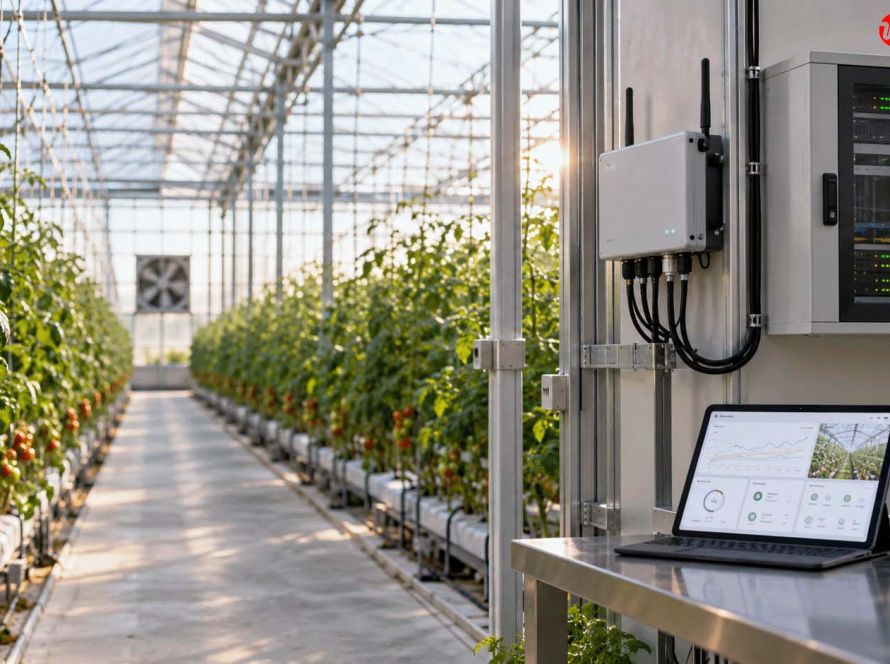
Modern commercial greenhouses can continuously monitor temperature, humidity, irrigation, equipment status and other production data.
Sensors, controllers and gateways can connect field equipment to a centralized automation system.
The basic architecture is explained in our greenhouse automation guide.
Accurate automation also depends on correct measurement locations. See our greenhouse sensor placement guide for additional information.
10. Greenhouse Commissioning After Construction
Completing physical installation does not mean that the greenhouse project is ready for operation.
Mechanical, electrical, irrigation and automation systems should be tested before production begins.
Mechanical Inspection
Structure, covering, motors, valves, pumps and pipe systems are inspected.
Electrical and Automation Tests
Sensors, controllers and communication with field equipment are tested.
Irrigation Tests
Flow, pressure, valve operation and different irrigation zones are checked.
Climate Control Tests
Heating, ventilation and alarm scenarios are tested under the configured control logic.
How Long Does Greenhouse Construction Take?
There is no single construction period that applies to every greenhouse project.
Greenhouse size, structural system, number of technical systems, site conditions, equipment supply and weather can all affect the total project schedule.
Smaller and simpler greenhouse projects may be completed more quickly, while commercial facilities with heating, irrigation, automation, electrical systems and extensive technical infrastructure naturally require more time.
What Determines Greenhouse Construction Cost?
Greenhouse construction cost cannot be determined only from the number of square meters.
Two greenhouses with the same floor area can have substantially different investment costs depending on their structural and technical specifications.
Structure
Structural system, steel quantity, covering and local load requirements affect cost.
Heating and Climate
Heating capacity, ventilation and climate-control equipment can represent a significant part of the investment.
Irrigation and Fertigation
Pumps, filters, tanks, dosing equipment and automation level influence total system cost.
Automation
Sensor count, control zones, gateways, remote monitoring and software infrastructure affect the investment.
Why Is Greenhouse Cost per Square Meter Not Enough?
“How much does a greenhouse cost per square meter?” is one of the most common questions asked during the early planning stage.
However, a square-meter price alone is not sufficient to compare two greenhouse projects.
One project may include only basic structure and covering, while another may include heating, climate control, fertigation, sensors, automation and cloud monitoring.
Cost comparisons should therefore be made only after confirming that the technical scope of the compared projects is similar.
Common Greenhouse Construction Mistakes
Building the Structure Before Planning Technical Systems
Adding heating, irrigation and automation later can make pipe, cable and equipment routing more difficult.
Focusing Only on Initial Cost
A lower initial investment can result in higher energy, maintenance or operating costs later.
Using the Same Design for Every Climate
The same greenhouse configuration may perform differently under different wind, snow and temperature conditions.
Ignoring Future Expansion
If additional greenhouse blocks or technical systems are planned, infrastructure should be sized accordingly.
Questions to Ask Before Building a Greenhouse
What crop will be grown?
Crop selection affects greenhouse height, irrigation, support systems and climate requirements.
During which seasons will production continue?
Year-round production and seasonal production can require very different heating and climate systems.
What level of automation is required?
Manual, semi-automatic and centralized control systems create different project requirements.
Will production capacity increase later?
Energy, irrigation and automation infrastructure should be designed for planned future expansion where necessary.
Why Integrated Engineering Matters in Greenhouse Construction
Structure, irrigation, heating, ventilation and automation are not completely independent systems.
Heating pipes and technical equipment can create additional structural loads. Sensor locations depend on greenhouse zones, while irrigation and climate-control zones influence automation architecture.
For investors who want these systems engineered and coordinated within one project, Agroteknik's turnkey greenhouse systems combine structural, heating, irrigation, automation and technical infrastructure requirements within an integrated project approach.
Evaluate Your Greenhouse Project
We can evaluate structural, heating, irrigation, climate-control and automation requirements according to your site, target crop and production capacity.