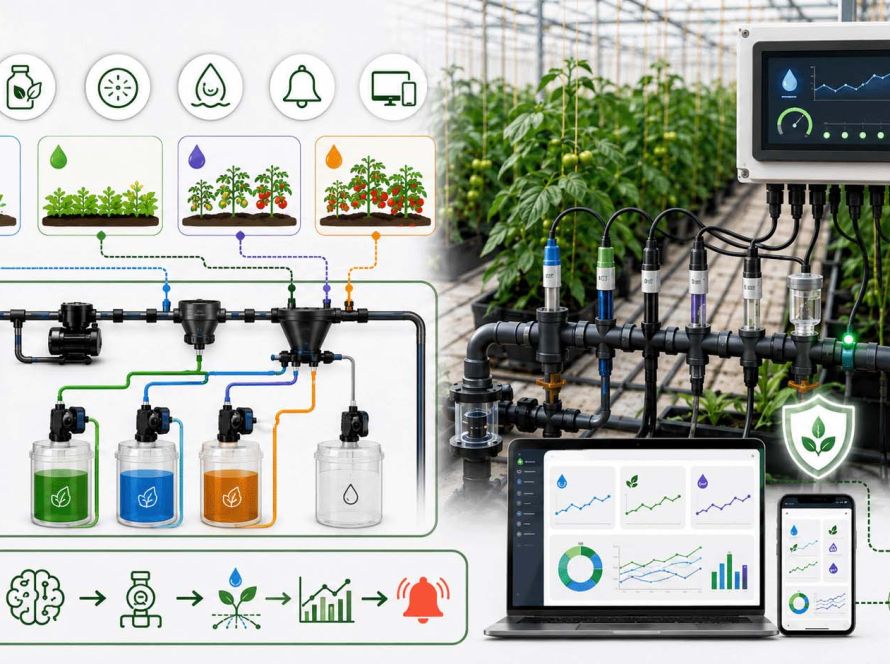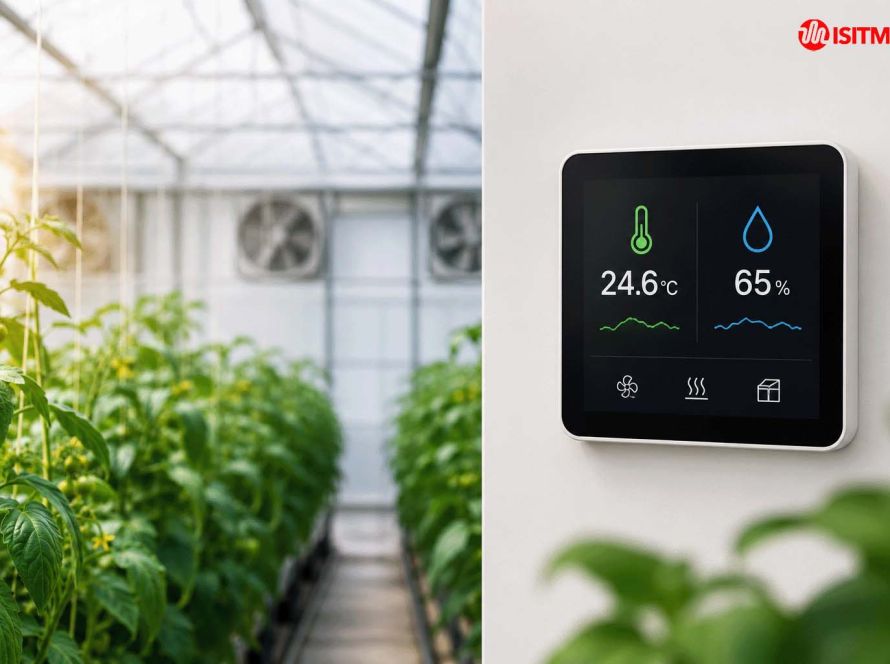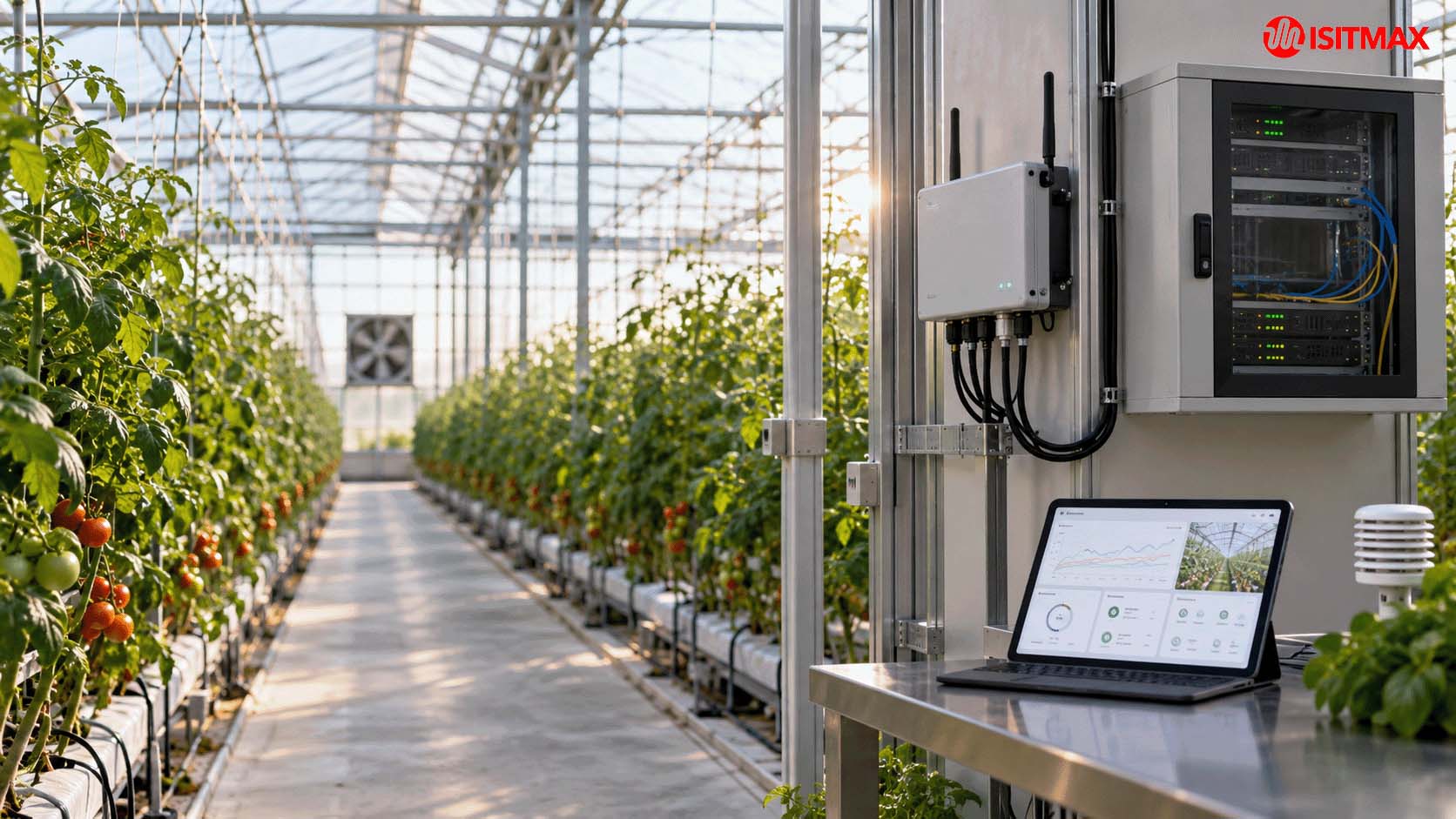
Greenhouse IoT data storage and cloud infrastructure connects sensors, controllers, gateways and software so that greenhouse operating data can be collected, transmitted, stored and analyzed over time. Instead of viewing only the current temperature or humidity value, a properly designed data infrastructure allows greenhouse operators to build a historical record of climate, irrigation, energy and equipment performance.
What Is Greenhouse IoT Data Infrastructure?
Greenhouse IoT infrastructure is the technical architecture used to transfer data from field devices to local or cloud-based software systems.
Sensors may measure temperature, humidity, CO₂, irrigation flow, pressure, EC, pH, root-zone conditions or energy consumption. Controllers and gateways then collect these measurements and transmit them to a central system.
This infrastructure is an important part of greenhouse automation and IoT because reliable automation requires both field control and dependable data communication.
How Does Greenhouse Data Reach the Cloud?
A typical greenhouse IoT architecture contains several layers between the physical sensor and the software dashboard used by the operator.
Measure greenhouse climate, irrigation and equipment conditions.
Read field signals and perform local automation functions.
Collects data and connects local field networks to IP networks.
Stores, processes and organizes greenhouse data.
Presents current values, trends, alarms and historical records.
What Greenhouse Data Can Be Stored?
Climate Data
Temperature, humidity, CO₂, light and other environmental measurements can be recorded over time.
Irrigation Data
Flow, pressure, irrigation duration, EC, pH and nutrient dosing information can be stored.
Equipment Status
Pumps, valves, fans, heaters and motors can report operating states and feedback signals.
Energy Data
Electricity and heating-related measurements can be compared with greenhouse operating conditions.
Alarm Records
High temperature, sensor failure, communication loss and equipment faults can be stored with timestamps.
Control History
Historical commands and equipment operation can provide context for later performance analysis.
Why Should Greenhouse Data Be Stored Historically?
Real-time monitoring answers the question “What is happening now?” Historical data helps answer “What has been happening over the last hours, days, weeks or production cycles?”
A current temperature reading alone cannot show whether a greenhouse repeatedly became too cold during the night or whether one production zone consistently experienced higher humidity.
Long-term data storage makes these patterns visible and allows greenhouse managers to investigate recurring problems rather than relying only on observations made at a single moment.
Local Data Storage or Cloud Storage?
| Criteria | Local Storage | Cloud Storage |
|---|---|---|
| Location | Data remains on equipment or servers at the greenhouse | Data is stored on remote cloud infrastructure |
| Remote access | Requires suitable remote-network configuration | Designed for access through internet-connected services |
| Scalability | Depends on local hardware capacity | Can be expanded according to platform architecture |
| Internet dependency | Local storage can continue without an external connection | Cloud transmission requires network connectivity |
| Multi-site monitoring | Requires additional integration | Can simplify centralized monitoring of multiple facilities |
Many practical greenhouse systems use a hybrid architecture: critical automation continues locally while data is also transferred to the cloud for monitoring, storage and analysis.
A greenhouse should not depend on cloud connectivity for every critical control action. Essential heating, irrigation or ventilation logic can remain operational locally while the cloud is used for remote monitoring, historical storage and higher-level analysis.
What Is a Greenhouse IoT Gateway?
An IoT gateway connects greenhouse field equipment with higher-level software or cloud systems.
Sensors and controllers may use industrial communication methods that are different from the network protocols used by cloud services. The gateway acts as the connection point between these layers.
Depending on the project, it can collect measurements, convert communication protocols, buffer data during network interruptions and transmit information to remote systems.
Which Communication Technologies Can Be Used?
Greenhouse IoT systems can use different communication technologies depending on the field equipment, distance, required reliability and existing infrastructure.
Industrial Serial Networks
Field controllers and sensors may use industrial serial communication within the greenhouse.
Ethernet
Wired IP networks can connect gateways, controllers and local servers where suitable infrastructure exists.
Wi-Fi
Wireless IP connectivity can be useful for suitable gateways and monitoring devices.
Cellular Connectivity
Mobile networks can provide connectivity where fixed internet infrastructure is unavailable or as a backup connection.
What Happens If the Greenhouse Internet Connection Fails?
A well-designed system should define what happens during an internet outage before the failure occurs.
Critical greenhouse control functions should not automatically stop simply because the cloud connection has been lost.
Local controllers can continue automation while the gateway temporarily buffers measurements. When communication returns, buffered data can be transferred to the central platform if the architecture supports it.
Local Control Continues
Critical climate and irrigation logic can remain on local automation equipment.
Connection Loss Is Detected
The system can identify that the gateway or cloud link is unavailable.
Data Is Buffered
Measurements may be retained locally where suitable buffering has been designed.
Synchronization Resumes
Stored measurements can be transmitted after network connectivity returns.
How Often Should Greenhouse IoT Data Be Stored?
There is no single correct recording interval for every greenhouse variable.
Fast-changing control signals may require shorter sampling intervals, while slower environmental or analytical variables may be recorded less frequently.
The system can also separate sampling frequency from cloud transmission. For example, local equipment may measure frequently while grouped measurements are transmitted at a different interval.
Recording frequency affects database size, network traffic and the level of detail available for later analysis.
How Long Should Greenhouse Data Be Retained?
Data-retention requirements depend on how the information will be used.
Short-term records may be sufficient for troubleshooting recent alarms, while production-cycle comparison and long-term performance analysis require longer historical datasets.
A suitable retention policy should therefore consider data volume, storage cost, reporting needs and the value of historical comparisons.
How Is Greenhouse Cloud Data Displayed?
Cloud software can convert raw sensor measurements into dashboards, charts, alarms and reports that are easier to interpret.
Current Conditions
View the latest temperature, humidity, irrigation and equipment status.
Historical Charts
Compare measurements across hours, days or longer production periods.
Alarm History
Review when critical events occurred and how long they remained active.
Multi-Zone Comparison
Compare climate or equipment behavior between greenhouse blocks.
Agroteknik's cloud-based greenhouse management platform can provide a centralized layer for remote monitoring and historical greenhouse data management.
How Are Alarms Managed in a Greenhouse Cloud System?
Alarms convert abnormal measurements and equipment failures into actionable events.
High temperature, low temperature, excessive humidity, abnormal EC or pH, missing sensor data, equipment failure and communication loss can all be monitored according to the project.
Storing alarm history also makes it possible to determine whether a problem is isolated or repeatedly occurs under similar conditions.
How Does Sensor Placement Affect Stored Data?
Cloud storage cannot correct a sensor that is measuring the wrong environment.
If a temperature sensor is installed directly beside a heating pipe, the cloud platform may accurately store an inaccurate representation of the greenhouse climate.
Sensor location should therefore be planned carefully before building the historical dataset. See our guide to greenhouse sensor placement for temperature, humidity, CO₂ and irrigation measurements.
How Can Greenhouse IoT Data Be Used for Analytics?
Once greenhouse information has been stored consistently, data from different systems can be compared.
Climate Performance
Determine how often greenhouse zones remained outside target conditions.
Energy Performance
Compare heating or electrical consumption with outside and inside climate conditions.
Irrigation Performance
Compare water and nutrient application between zones and production periods.
Equipment Performance
Review runtime, alarms and operation patterns for pumps, fans, heaters and other equipment.
Can Greenhouse Data Be Used for Artificial Intelligence?
Artificial intelligence and machine-learning systems require usable historical data before meaningful analysis can be performed.
A greenhouse that has stored consistent climate, irrigation, equipment and production information over time provides a stronger foundation for advanced analytics than a greenhouse that only displays current sensor values.
Historical IoT datasets can support AI and machine-learning applications designed to identify patterns, compare operating conditions and support greenhouse decision-making.
Common Greenhouse IoT Infrastructure Mistakes
Depending Entirely on the Cloud
Critical greenhouse control should have an appropriate local operating strategy during network interruptions.
Collecting Data Without a Purpose
Recording every signal at extremely short intervals can create large datasets without adding useful information.
Ignoring Communication Failures
Missing sensor data and disconnected devices should be detectable instead of silently producing gaps.
Not Planning Device Identification
Sensors and equipment should be clearly associated with greenhouse blocks, zones and measurement types.
How Should a Greenhouse IoT System Be Planned?
Define What Must Be Measured
Determine which climate, irrigation, energy and equipment variables are actually useful.
Define Local Control
Identify which functions must continue even when the internet or cloud service is unavailable.
Design the Communication Architecture
Plan controllers, field networks, gateways and internet connectivity as one system.
Plan Storage and Visualization
Define data intervals, retention, dashboards, alarms and reporting requirements.
IoT Infrastructure in Turnkey Greenhouse Projects
IoT infrastructure is easier to implement when sensors, cabling, controllers, gateways and network requirements are considered during the greenhouse engineering stage.
Within Agroteknik's turnkey greenhouse projects, field devices, automation, communication infrastructure, cloud connectivity and data storage can be evaluated as parts of the same architecture.
This reduces the need to retrofit disconnected monitoring systems after the greenhouse is already operational.
Plan Your Greenhouse IoT Infrastructure
We can evaluate sensors, controllers, gateways, communication, local data storage, cloud connectivity, dashboards and historical data requirements for your greenhouse project.