Greenhouse heating system design starts with calculating how much heat the greenhouse loses under the expected winter conditions. Greenhouse size alone is not enough to select heating capacity. Covering material, outside temperature, target indoor temperature, wind, air leakage, greenhouse geometry and heat distribution must all be considered before boilers, pipes or other heating equipment are selected.
How Is a Greenhouse Heating System Designed?
A greenhouse heating project begins by defining the environmental conditions that the facility needs to maintain during the coldest expected operating periods.
The required heating capacity depends on how quickly heat leaves the greenhouse and how large the temperature difference is between the desired indoor condition and the outdoor environment.
Heating should therefore be considered during the initial turnkey greenhouse design stage rather than after the greenhouse structure has already been completed.
What Determines Greenhouse Heating Capacity?
Greenhouse heating capacity is influenced by several technical variables that should be evaluated together.
Larger external surfaces generally create greater heat-transfer potential.
Heating demand rises as the difference between indoor and outdoor temperature increases.
Glass, film and polycarbonate systems have different thermal properties.
Infiltration and ventilation can create additional heat losses.
What Is Greenhouse Heat Loss?
Greenhouse heat loss is the thermal energy that leaves the production environment and must be replaced by the heating system to maintain the target temperature.
Heat can leave the greenhouse through the covering, structural elements, air leakage and intentional ventilation.
The total heat loss under design conditions provides the basis for selecting the required heating-system capacity.
Transmission Loss
Heat passes through greenhouse covering materials because indoor and outdoor temperatures are different.
Air Infiltration
Uncontrolled outdoor air entering through openings and leakage increases heating demand.
Ventilation Loss
Warm internal air carries heat out when the greenhouse is ventilated.
Distribution Loss
Heating pipes and equipment may also lose energy before heat reaches the crop area.
How Is Greenhouse Heat Loss Calculated?
A simplified heat-loss calculation generally considers the greenhouse surface area, thermal transmission coefficient of the covering and the difference between indoor and outdoor design temperatures.
In practical engineering, additional corrections may be required for air infiltration, wind exposure, greenhouse geometry and other project conditions.
This is why heating capacity should not be selected only from a simple watts-per-square-meter assumption when designing commercial greenhouse projects.
Two greenhouses with the same floor area can require very different heating capacities if their covering systems, heights, climate conditions and target temperatures are different.
How Does Greenhouse Covering Affect Heating Demand?
The greenhouse covering separates the controlled production environment from the outside climate and therefore has a major influence on heat loss.
| Factor | Effect on Heating |
|---|---|
| Covering type | Different materials transfer heat at different rates |
| Number of layers | Additional layers can improve thermal resistance |
| Sealing quality | Poor sealing increases uncontrolled air infiltration |
| Surface area | More exposed surface generally increases transmission losses |
| Greenhouse height | Influences total volume, external area and heat distribution |
How Should Outdoor Design Temperature Be Selected?
Heating systems should be designed according to realistic winter conditions for the greenhouse location.
Using an outdoor temperature that is too high can result in insufficient heating capacity during cold weather. Selecting an unnecessarily extreme value can increase equipment size and investment cost.
Regional climate information and project-specific design criteria should therefore be evaluated during engineering.
How Is Heat Distributed Inside a Greenhouse?
Generating enough heat is only one part of greenhouse heating design. That heat must also be distributed effectively across the crop area.
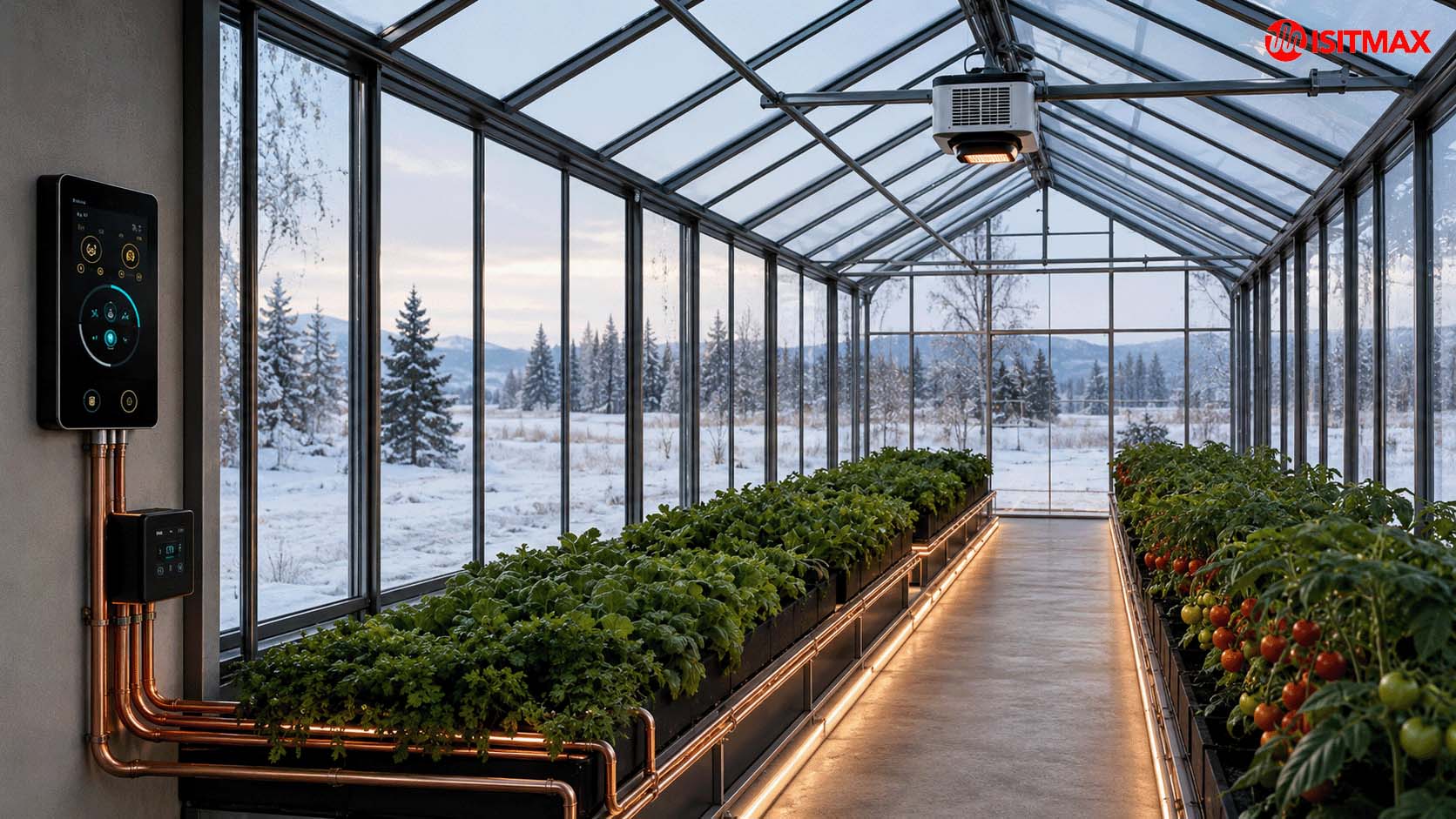
Depending on the project, heating can use pipe networks, localized heating systems or other heat-distribution methods.
Perimeter Heating
Heating elements can be positioned around external greenhouse zones where heat loss may be greater.
Crop-Level Heating
Heat can be distributed closer to the crop to influence the production environment directly.
Root-Zone Heating
Targeted systems can deliver heat directly around the root zone.
Zoned Heating
Different greenhouse blocks can be controlled according to separate temperature requirements.
What Is Root-Zone Heating?
Root-zone heating provides heat directly around the root environment rather than relying only on the general greenhouse air temperature.
Depending on the crop and production system, this approach can provide more targeted temperature management.
Agroteknik's root-zone heating solutions can be integrated with temperature sensors and automation systems to monitor and control root-zone conditions.
Should a Greenhouse Be Divided into Heating Zones?
Large greenhouse facilities can experience different thermal conditions across separate blocks.
Orientation, crop type, greenhouse geometry, external exposure and pipe layout can all influence temperature distribution.
Dividing the greenhouse into heating zones can allow individual areas to be monitored and controlled according to their actual requirements.
How Does Heating Automation Work?
Heating automation uses temperature sensors and control logic to decide when heating equipment should operate.
The control system may consider greenhouse temperature, root-zone temperature, outside temperature, time schedules and different production zones.
Heating automation can be integrated with broader greenhouse climate control automation so that heating and ventilation do not operate independently or conflict with each other.
How Can Greenhouse Heating Energy Consumption Be Reduced?
Calculate Heating Capacity Correctly
Equipment should be selected according to realistic heat-loss calculations.
Improve Heat Distribution
Poor distribution can create cold zones even when total installed capacity is sufficient.
Use Zoned Control
Different areas can be heated according to their actual requirements.
Monitor Historical Data
Comparing energy use with outside and greenhouse temperatures can reveal unusual operating periods.
Common Greenhouse Heating Design Mistakes
Using Only Greenhouse Floor Area
Floor area alone does not account for covering, height, climate or temperature difference.
Ignoring Air Leakage
Infiltration can create significant additional heat demand.
Installing Capacity Without Distribution Planning
Large heating capacity cannot compensate for poor heat distribution.
Designing Heating Separately from Automation
Heating, sensors, ventilation and control logic should be evaluated as parts of the same climate system.
Greenhouse Heating in Turnkey Greenhouse Projects
Heating infrastructure affects greenhouse structure, pipe routes, energy systems, automation and climate control.
Within Agroteknik's turnkey greenhouse projects, heating capacity, pipe distribution, climate sensors, automation and energy infrastructure can be evaluated during the initial design stage.
Planning these systems together reduces the risk of trying to adapt heating infrastructure to a greenhouse that was designed without considering its thermal requirements.
Plan Your Greenhouse Heating System
We can evaluate greenhouse heat loss, required heating capacity, heat distribution, root-zone heating, automation and energy infrastructure according to your project conditions.