Greenhouse fertigation automation combines irrigation, fertilizer dosing, sensors and control systems to deliver water and nutrients according to predefined production strategies. A properly designed automated fertigation system can improve consistency, make resource consumption measurable and reduce the need for repetitive manual adjustments in commercial greenhouse operations.
What Is Greenhouse Fertigation Automation?
Fertigation is the application of dissolved nutrients through the irrigation system. In a greenhouse, this process can be automated by connecting pumps, dosing units, valves, tanks, sensors and controllers within the same technical infrastructure.
The automation system can manage irrigation timing, irrigation duration, nutrient dosing and different irrigation zones according to the required production strategy.
Greenhouse fertigation automation can be integrated with broader greenhouse automation systems so that irrigation, climate, sensors and equipment monitoring operate within the same control environment.
How Does an Automated Fertigation System Work?
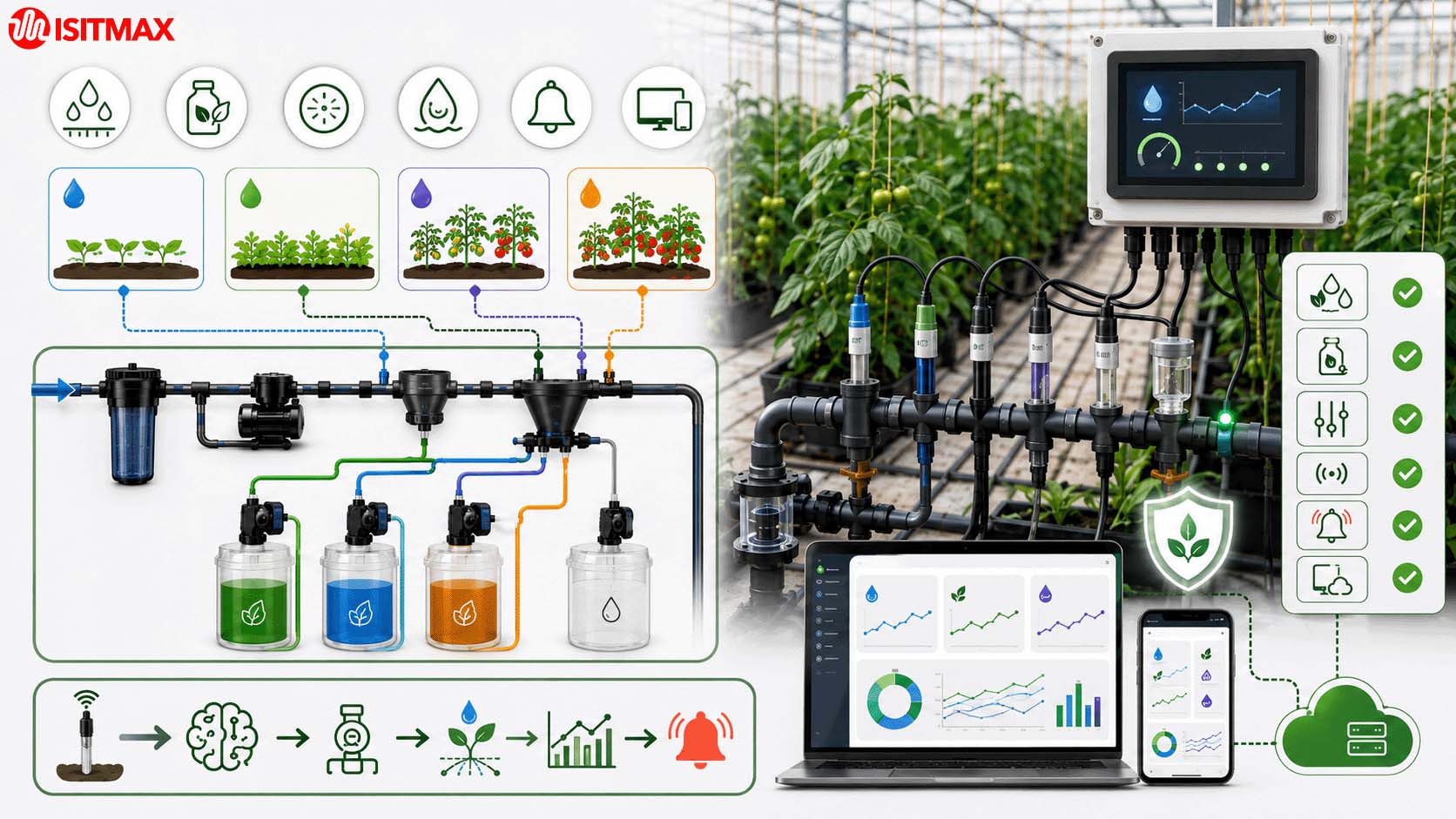
A typical fertigation system starts with water and nutrient preparation and ends with controlled delivery to one or more greenhouse irrigation zones.
Water enters the irrigation system from the available source or storage tank.
Fertilizer solutions are injected according to the selected recipe.
Sensors and controllers evaluate system values and manage dosing.
Pumps and valves distribute the prepared solution to selected crop zones.
Which Components Are Used in Greenhouse Fertigation Systems?
Water and Nutrient Tanks
Store irrigation water and concentrated fertilizer solutions required for nutrient preparation.
Dosing Pumps
Inject controlled quantities of fertilizer solution into the irrigation water.
EC and pH Sensors
Measure important properties of the irrigation solution and provide feedback to the control system.
Flow Meters
Measure water or nutrient-solution flow and help verify actual irrigation quantities.
Valves and Irrigation Zones
Divide the greenhouse into independently controlled irrigation sections.
Automation Controller
Manages dosing sequences, pumps, valves, alarms and irrigation programs.
Why Are EC and pH Important in Greenhouse Fertigation?
EC and pH are commonly monitored parameters in greenhouse fertigation systems.
Electrical conductivity, or EC, provides information about the concentration of dissolved salts in the irrigation solution. pH indicates the acidity or alkalinity of the solution.
The correct target values depend on the crop, growing medium, water quality and production strategy. For this reason, the automation system should not rely on universal EC or pH values for every greenhouse.
Sensor calibration and reliable measurement are also important because inaccurate data can cause incorrect dosing decisions.
What Can a Greenhouse Fertigation Controller Manage?
| Function | Typical Control |
|---|---|
| Irrigation timing | Start time, duration and irrigation frequency |
| Fertilizer dosing | Controlled dosing from one or more nutrient tanks |
| EC monitoring | Measurement and adjustment according to the configured strategy |
| pH monitoring | Measurement and dosing control where suitable equipment is installed |
| Irrigation zones | Independent operation of valves and production areas |
| Alarms | Sensor faults, flow problems and values outside configured ranges |
How Should Irrigation Zones Be Designed?
Large greenhouses should not always be treated as one irrigation zone. Different greenhouse blocks, crops, production stages or hydraulic conditions may require separate control.
Dividing the facility into suitable irrigation zones allows the system to apply different schedules and nutrient strategies where required.
Zone design should consider pipe sizing, pressure losses, valve capacity, irrigation uniformity and the total simultaneous flow requirement.
Fertigation automation should not be designed only around software. Hydraulic design, water quality, dosing equipment, sensors and control logic must work together for the system to operate reliably.
Common Mistakes in Greenhouse Fertigation Automation
Ignoring Water Quality
Source-water EC, pH and other characteristics should be evaluated before defining nutrient and dosing strategies.
Using Too Few Measurement Points
Measuring only at one location may not represent conditions across large or hydraulically complex irrigation systems.
Neglecting Sensor Calibration
EC and pH sensors require appropriate maintenance and calibration to provide reliable control data.
Designing Automation Separately from Hydraulics
Control logic cannot compensate for incorrect pipe sizing, poor pressure balance or unsuitable irrigation-zone design.
How Are Fertigation Alarms Used?
Alarm management is an important part of automated greenhouse irrigation. The system can monitor whether measured conditions remain within expected ranges.
EC Outside Target Range
Unexpected EC values may indicate dosing, sensor or water-quality problems.
pH Outside Target Range
The system can generate an alarm when measured pH moves outside configured limits.
Low or Missing Flow
Flow measurements can help identify blocked lines, pump problems or incorrectly operating valves.
Sensor or Communication Failure
Missing measurements or communication loss can be identified before incorrect control continues for long periods.
Can Greenhouse Fertigation Be Monitored Remotely?
Yes. When the automation controller is connected to an IoT and cloud infrastructure, irrigation and fertigation data can be transferred to a centralized platform.
Operators can monitor information such as irrigation activity, alarms, equipment status and historical measurements through remote interfaces.
Agroteknik's cloud-based greenhouse management platform can support centralized monitoring and historical storage of greenhouse automation data.
IoT communication and historical storage can also be integrated with Agroteknik's greenhouse IoT data infrastructure .
How Can Fertigation Data Be Used for Analytics?
Once irrigation and nutrient data are stored consistently, they can be compared with climate conditions and production results.
Greenhouse managers may evaluate:
Water Consumption
Compare irrigation volumes between greenhouse blocks and production cycles.
Nutrient Application
Track fertilizer dosing patterns and compare them with production periods.
System Performance
Analyze pump activity, valve operation, alarms and irrigation durations.
Production Relationships
Investigate relationships between irrigation, climate and crop performance.
Fertigation Automation in Turnkey Greenhouse Projects
In new greenhouse investments, irrigation and fertigation systems are easier to integrate when they are planned during the initial engineering stage.
Within Agroteknik's turnkey greenhouse projects, water supply, irrigation zones, pumps, dosing equipment, sensors, automation and data infrastructure can be evaluated together.
This allows hydraulic design and control architecture to be coordinated before installation rather than requiring separate systems to be connected later.
What Should You Consider When Choosing a Greenhouse Fertigation System?
Start with Crop and Water Requirements
The system should be designed according to crop requirements, water quality and the selected growing method.
Design Hydraulics and Automation Together
Pipework, pumps, valves, dosing and control logic should be planned as parts of the same system.
Use Reliable Sensors
Measurement quality directly affects dosing decisions and alarm reliability.
Plan for Expansion
Future greenhouse zones, additional dosing channels and remote monitoring should be considered during system design.
Plan Your Greenhouse Fertigation Automation
We can evaluate irrigation zones, nutrient dosing, sensors, automation, IoT and remote monitoring requirements for new or existing greenhouse facilities.