ISITMAX Weld-Free Greenhouse Frame
A bolted, modular, galvanized steel greenhouse frame for hobby and R&D greenhouses
Assembled on site with bolts and self-drilling screws, with no welding; it can be dismantled and moved, and extended with new modules. Every project is calculated for wind and snow loads.
- Our own production
- Weld-free assembly
- Can be moved
- Extendable
What is a weld-free greenhouse frame?
A weld-free greenhouse frame is a greenhouse structure in which the steel load-bearing members are joined on site with connection pieces, bolts and self-drilling screws, with no welding.
The parts are made to the dimensions of the project during production and assembled on site with mechanical joints. Because there is no welding, the galvanized coating is preserved at the joints; because the joints can be undone, the greenhouse can be moved, extended and have parts replaced.
In a conventional welded greenhouse frame the joints are permanent: moving the greenhouse, extending it or replacing a part requires cutting and re-welding. A bolted greenhouse frame does the same work with joints that can be taken apart. This makes it a good solution especially for small hobby and R&D greenhouses that need to be used flexibly.
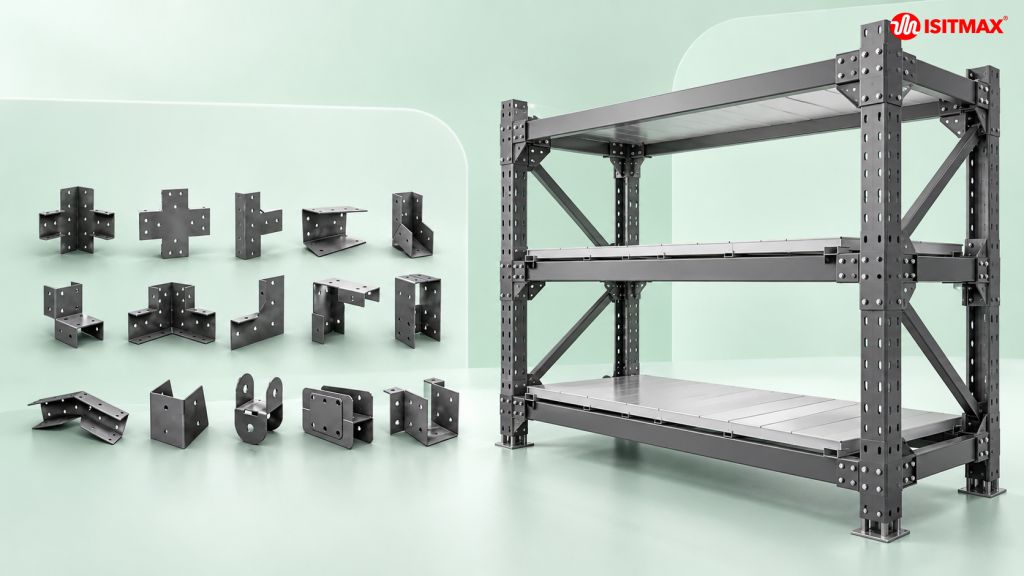
A weld-free frame for hobby and R&D greenhouses
The ISITMAX weld-free frame was developed for small greenhouses. In a hobby greenhouse, easy installation and the option to extend later stand out; in an R&D greenhouse, an orderly, measurable structure that can be rearranged when needed. Large-scale commercial production greenhouses are designed separately as turnkey greenhouse projects.
Hobby greenhouses
A bolted steel greenhouse frame that needs no welding, for people who want to grow their own produce in a garden or on a small plot.
- Small-scale growing
- Can be dismantled and moved
- Can be extended as needs grow
R&D and trial greenhouses
An orderly, modular frame that can be rebuilt when needed, for small greenhouses used for trial growing and research.
- Trial and research areas
- Suitable for relocation
- Grows by adding modules
Planning a commercial production greenhouse?
Large-scale projects are planned on a turnkey basis together with the structure, heating, climate control and irrigation systems.
Go to turnkey greenhouses- 1Galvanized steel profiles
- 2Bolted nodes
- 3Fixing with self-drilling screws
- 4New module for extension
Components of the weld-free greenhouse frame
The frame consists of the main load-bearing frames, the members that connect them lengthwise and the bracing that stabilizes the structure. All joints are weld-free. How the frame is anchored to the ground is decided according to the site.
- 1
Galvanized steel profiles
The steel parts that form the main load-bearing frames, the longitudinal members and the bracing of the greenhouse. Pre-galvanized as standard, hot-dip galvanized on request.
- 2
Bolted nodes
Where members meet, they are joined with bolts and nuts through connection pieces; a joint can be taken apart when needed.
- 3
Fixing with self-drilling screws
At suitable joints, self-drilling screws with a drill-bit tip drill the hole and fix the part in one step.
- 4
New module for extension
The greenhouse is made longer by adding new modules produced with the same system.
- APost
- BConnection piece
- CBolt and nut
- DSelf-drilling screw
- EBeam
Bolted greenhouse frame: how is weld-free assembly done?
No welding machine, welding labour or paint and coating repair after welding is needed on site. The parts are connected mechanically: posts and beams are bolted together through connection pieces and fixed with self-drilling screws at suitable points.
The position and number of joints are determined by the structural calculation. The weld-free joints are therefore planned to suit the loads the greenhouse has to carry.
Bolted joint
Load-bearing members are joined with bolts and nuts through connection pieces. The joint can be taken apart; a part can be replaced or the system moved elsewhere when needed.
Fixing with self-drilling screws
Self-drilling screws with a drill-bit tip drill the hole and fix the part in one step. At suitable joints they allow quick, weld-free assembly.
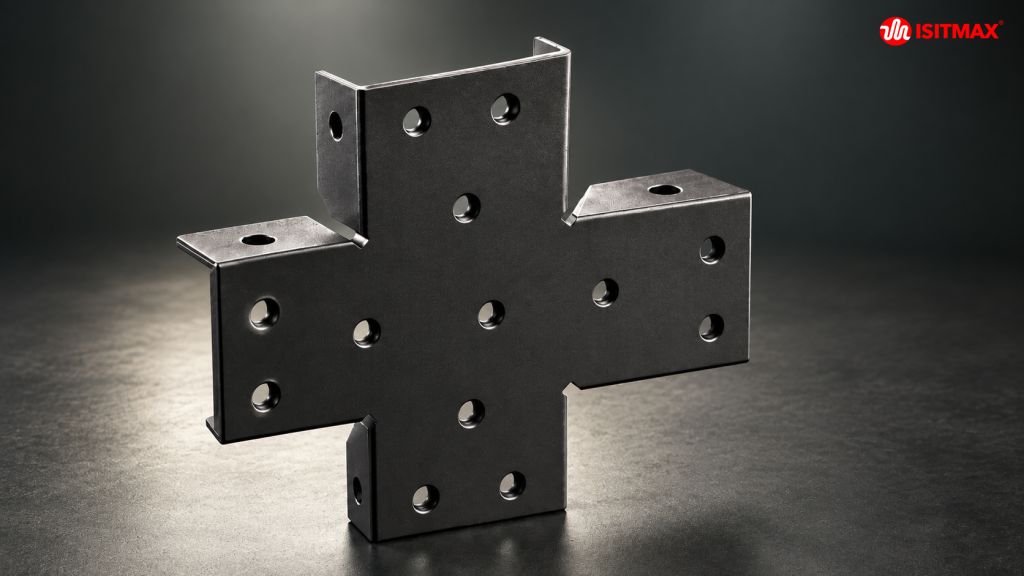
Bracing connection plate
Joins several profiles with bolts at a single node.
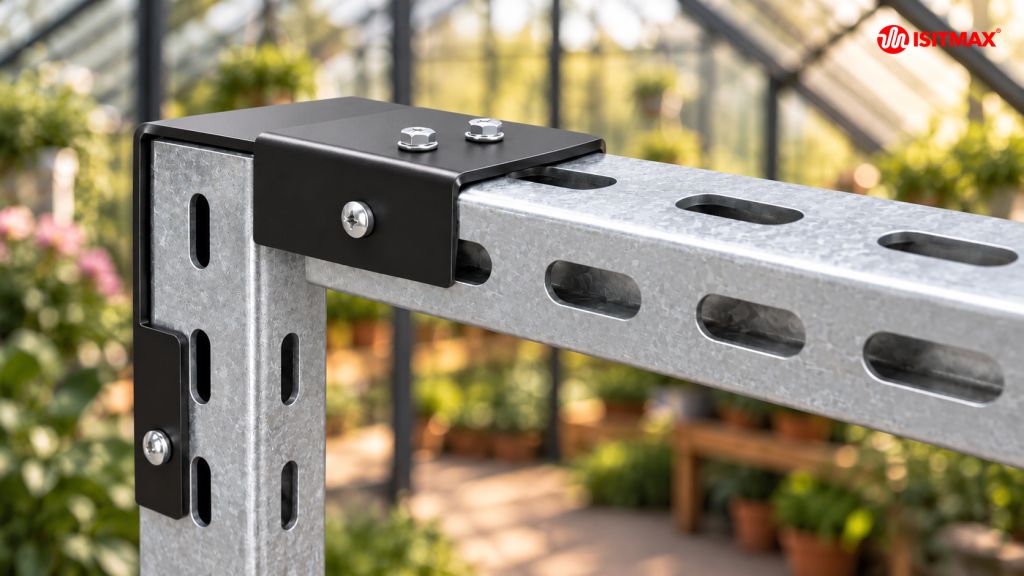
Beam-to-post connection
The beam sits on the post through a connection piece, with no welding.
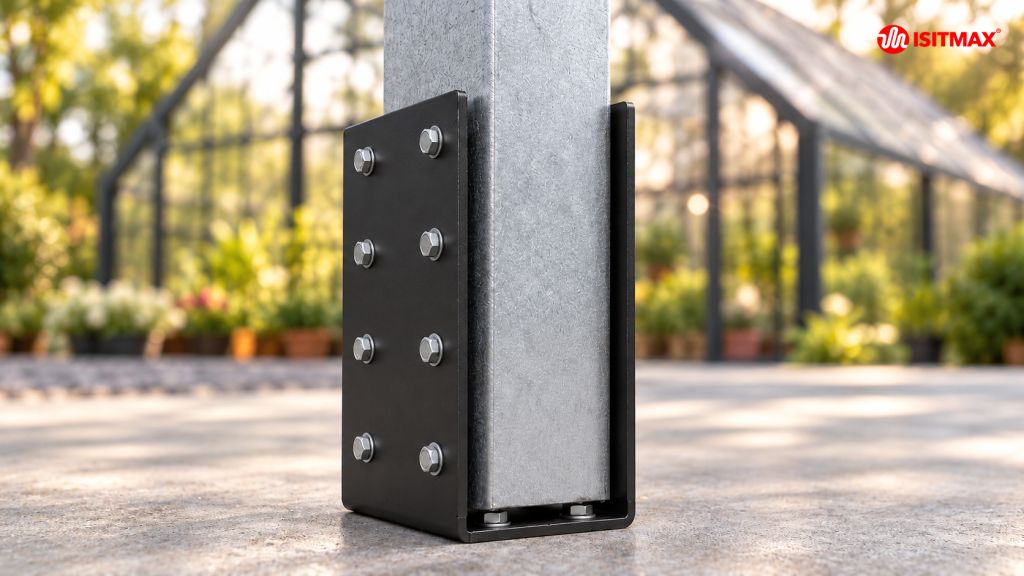
Post connection
The post is fixed to the connection piece with bolts.
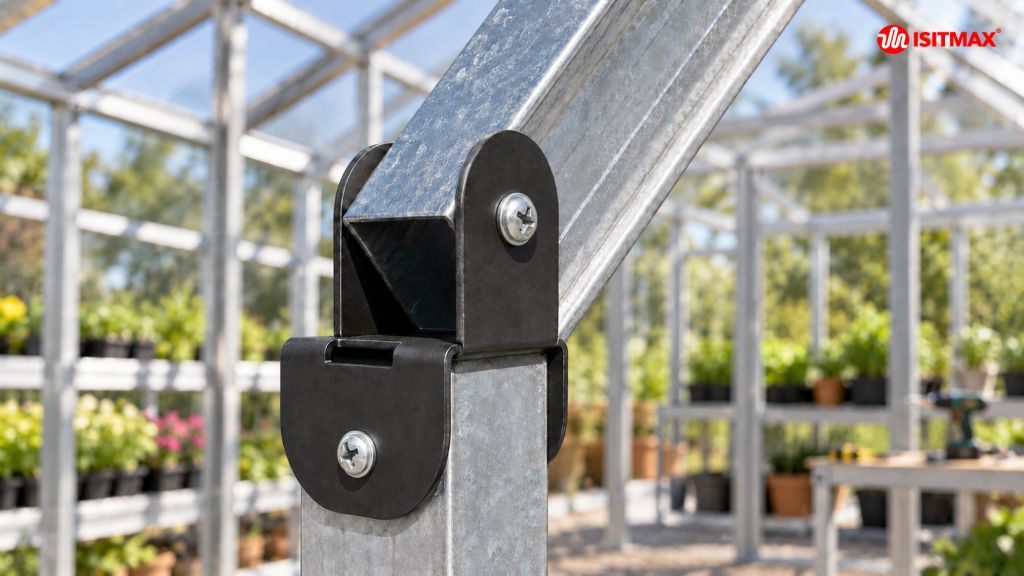
Roof connection
Sloping roof members are joined with a connection that can be taken apart.
Galvanized greenhouse frame: pre-galvanized and hot-dip
The inside of a greenhouse is a humid environment, so protecting the steel with galvanizing is important for the life of the frame. The ISITMAX weld-free frame uses pre-galvanized steel as standard, with hot-dip galvanizing on request. Because there is no welding, the galvanized coating is preserved at the joints too.
Pre-galvanized
Steel sheet or tube is supplied already galvanized on the production line, then cut and formed into frame parts. It gives a smooth, clean surface.
- Used in standard production
- The usual choice for hobby and R&D greenhouses
Hot-dip galvanized
After fabrication, the parts are dipped into a bath of molten zinc. The whole surface is coated, including cut edges and holes, and the coating is thicker.
- Applied on request
- For more demanding environments
Greenhouse frame calculation for wind and snow loads
Even a small greenhouse has to withstand wind and snow loads. That is why the load-bearing members of the ISITMAX weld-free frame are calculated for each project, and profiles and joints are chosen according to this calculation.
The calculation considers the information below. Sharing it when you ask for a quote speeds up the process.
- Project locationWind and snow conditions of the region
- Greenhouse dimensionsWidth, length and height
- CoveringThe covering to be used and its weight
- Intended useHobby or R&D use and equipment
Modular greenhouse frame: dismantle, move, extend
Bolted joints give flexibility throughout the life of the greenhouse. It can be extended where it stands, dismantled and re-erected elsewhere when needed, and damaged parts can be replaced one by one.
-
Can be dismantled
The joints are undone and the greenhouse is taken apart.
-
Can be moved
It is re-erected elsewhere when needed.
-
Can be extended
The greenhouse grows by adding new modules.
-
Parts can be replaced
The member is unbolted and a new one fitted.
Advantages of a weld-free greenhouse frame
Weld-free joints make things easier at every stage of a small greenhouse, from installation and use to future extension.
The galvanized coating is preserved
Welding can damage the galvanized coating. With weld-free joints the coating is preserved at the connection points too, so corrosion protection continues in the humid greenhouse environment.
No welding on site
Assembly needs no welding machine, no welding labour and no paint or coating repair after welding; installation is done with hand tools.
Can be dismantled and moved
By opening the bolted and screwed joints, the greenhouse is taken apart and can be re-erected elsewhere. A major advantage for greenhouses on rented land or temporary sites.
Grows by adding modules
When needs increase, the greenhouse is extended with new modules; there is no need to cut the existing frame or weld again.
Easy part replacement
A damaged member is replaced by undoing only the relevant joints; the rest of the system stays in place.
Our own production
The frame is produced by ISITMAX. Parts are made to the dimensions of the project and planned together with the structural calculation.
Welded vs. weld-free greenhouse frames
| Topic | Welded frame | ISITMAX weld-free |
|---|---|---|
| Site joints | Welding | Bolts and self-drilling screws |
| Galvanized coating | Can be damaged at weld points | Preserved at the joints |
| Equipment needed on site | Welding machine and power | Hand tools for assembly |
| Dismantling and moving | Welded joints cannot be taken apart | Can be dismantled and re-erected |
| Extension | Needs new welding work | By adding a new module |
| Part replacement | Cutting and re-welding | The part is unbolted and replaced |
This comparison is for general information.
What to look for when choosing a weld-free greenhouse frame
When choosing a frame for a hobby or R&D greenhouse, look not only at the dimensions but also at where and how the greenhouse will be used. We clarify the points below together at the quotation stage.
- 01
Is a structural calculation made?
A load-bearing system calculated for the wind and snow loads of the site is the basis of safety, even for small greenhouses.
- 02
Which galvanizing?
Pre-galvanizing and hot-dip galvanizing offer different levels of protection. The choice should match the environment where the greenhouse will stand.
- 03
Connection details
Bolted and screwed joints that can be taken apart make it possible to move and extend the greenhouse later.
- 04
Dimensions and purpose
The width, length and height of the greenhouse and the hobby or R&D work planned inside should be considered together.
- 05
Covering
The covering to be used and its weight are taken into account in the structural calculation.
- 06
Future plans
If the greenhouse will be extended or moved in future, a modular system that can be dismantled should be chosen.
Maintaining a weld-free greenhouse frame
Maintaining a bolted greenhouse frame is simple; a few regular checks help keep the frame in good condition for a long time.
- Check the tightness of bolted joints at regular intervals.
- Inspect the load-bearing members visually after storms and heavy snowfall.
- Replace a damaged or bent part by undoing the relevant joints.
- Preventing water from pooling on the greenhouse floor helps protect the members near the ground.
- If the greenhouse is to be moved, marking the parts as they are dismantled makes re-assembly easier.
ISITMAX weld-free frame installations
The ISITMAX weld-free frame process: from request to assembly
- 01
Needs and dimensions
The intended use, greenhouse dimensions, covering and project location are defined.
- 02
Structural calculation
The load-bearing system is calculated for the wind and snow loads of the region.
- 03
Choice of galvanizing
Pre-galvanized or, on request, hot-dip galvanized is decided.
- 04
ISITMAX production
The frame parts are produced by ISITMAX.
- 05
Weld-free assembly
The parts are joined with bolts and self-drilling screws.
Complementary solutions for small greenhouses
Frequently asked questions about weld-free greenhouse frames
If your question is not answered here, call us and we will answer it for your project.
What is a weld-free greenhouse frame?
It is a greenhouse frame system in which the steel load-bearing members are joined on site with connection pieces, bolts and self-drilling screws, with no welding. Because there is no welding, the galvanized coating is preserved; because the joints can be undone, the greenhouse can be moved and extended.
Who makes the ISITMAX weld-free frame?
Agroteknik is the greenhouse brand of ISITMAX İklimlendirme Sistemleri Sanayi ve Ticaret A.Ş. The weld-free greenhouse frame is ISITMAX’s own production.
Which greenhouses is it suitable for?
The ISITMAX weld-free frame was developed for small greenhouses, that is, hobby greenhouses and R&D and trial greenhouses. Large-scale commercial production greenhouses are designed separately as turnkey greenhouse projects.
How are the parts joined?
Load-bearing members are joined through connection pieces with bolts and nuts or with self-drilling screws. No welding is done on site.
What is a self-drilling screw?
A self-drilling screw has a drill-bit tip that drills its own hole as it is fixed. Because drilling and fixing are done in one step, it allows quick, weld-free assembly at suitable joints.
Is a weld-free frame as strong as a welded one?
The strength of a greenhouse frame depends on the correct calculation of the load-bearing system and on the connection details. For the ISITMAX weld-free frame, a wind and snow load calculation is made for each project, and profiles and joints are chosen according to this calculation.
What is the difference between pre-galvanized and hot-dip galvanized?
With pre-galvanizing, steel sheet or tube is supplied already galvanized and then cut and formed. With hot-dip galvanizing, the parts are dipped in a bath of molten zinc after fabrication; the whole surface, including cut edges and holes, is coated and the coating is thicker.
Can I have it hot-dip galvanized?
Yes. Pre-galvanized steel is generally used in standard production; on request, the frame is produced hot-dip galvanized.
Is a wind and snow load calculation made?
Yes. For each project, the load-bearing system is calculated taking into account the wind and snow conditions of the project location, the greenhouse dimensions and the covering.
Can the greenhouse be dismantled and moved elsewhere?
Yes. By undoing the bolted and screwed joints, the greenhouse can be taken apart and re-erected in another location.
Which galvanizing is suitable for a hobby greenhouse?
Standard pre-galvanized steel is generally used for hobby and R&D greenhouses. Where the greenhouse will stand in more demanding conditions, hot-dip galvanizing can be chosen; we make the choice together at the quotation stage.
Can the greenhouse be extended later?
Yes. The weld-free frame is modular; the greenhouse can be extended by adding new modules.
Can heating or automation be added to a small greenhouse?
This is assessed according to the need. For example, electric root-zone heating can be used in small, hobby and R&D greenhouses; climate control and other systems are planned according to the needs of the project.
What does the price depend on?
The price depends on the greenhouse dimensions, the type of galvanizing (pre-galvanized or hot-dip), the covering, the wind and snow load of the project location and any additional needs. When you share your details, a quote is prepared for you.
Get a quote for a weld-free greenhouse frame
Tell us the intended use, approximate dimensions, covering and location of the greenhouse, and we will prepare the right frame for you based on the structural calculation.