
Root-Zone Heating Systems and Ground-Source Root-Zone Heating for Greenhouses
We take the stable heat deep in the ground with heat exchangers and carry it to the plant’s roots through pipes laid below the root zone. The same system warms the root zone in winter and helps cool it in summer.
What is root-zone heating and why does it matter?
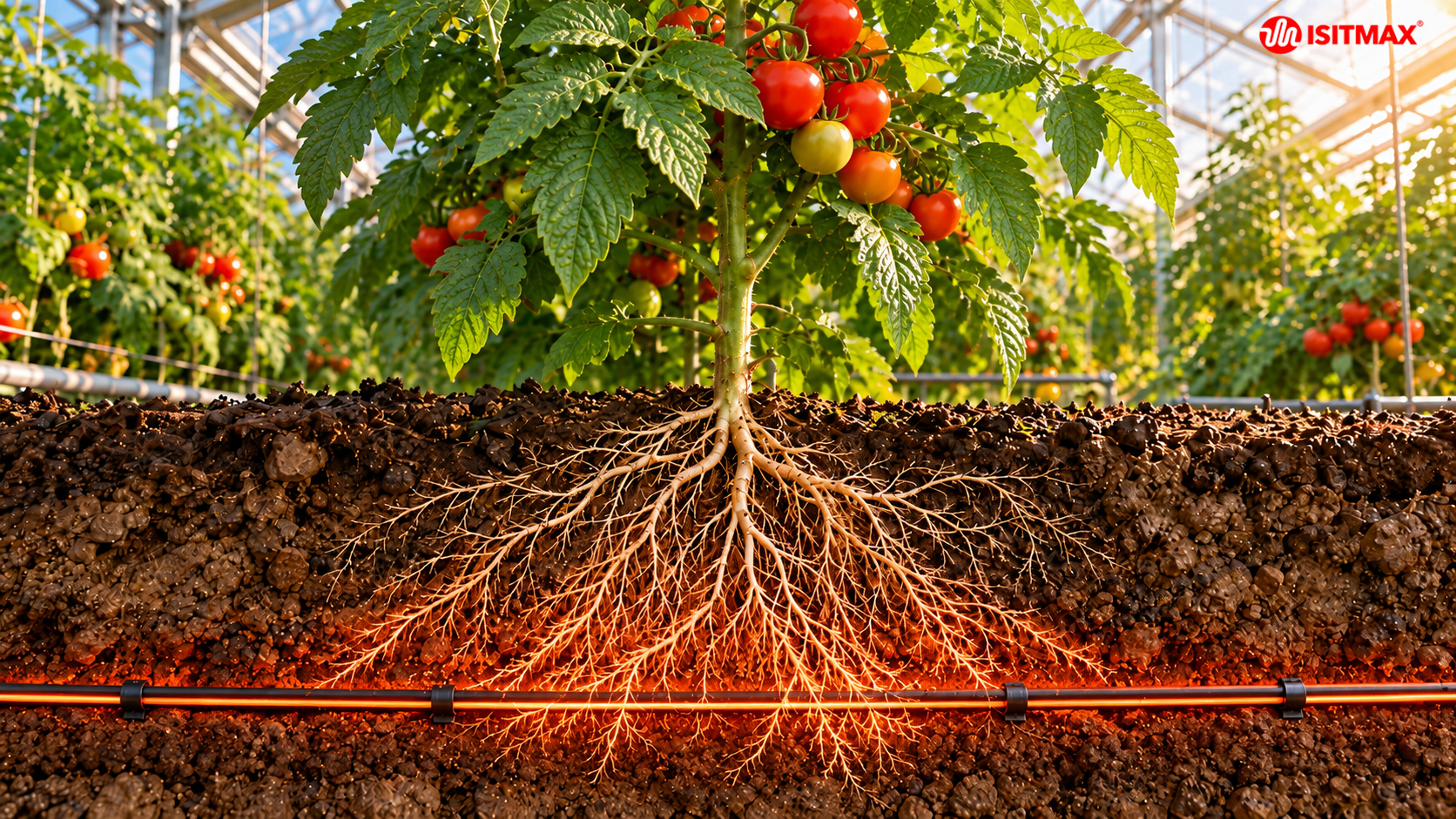
Root-zone heating is a heating method that delivers heat directly to the soil where the plant’s roots are, instead of raising the whole greenhouse air to high temperatures.
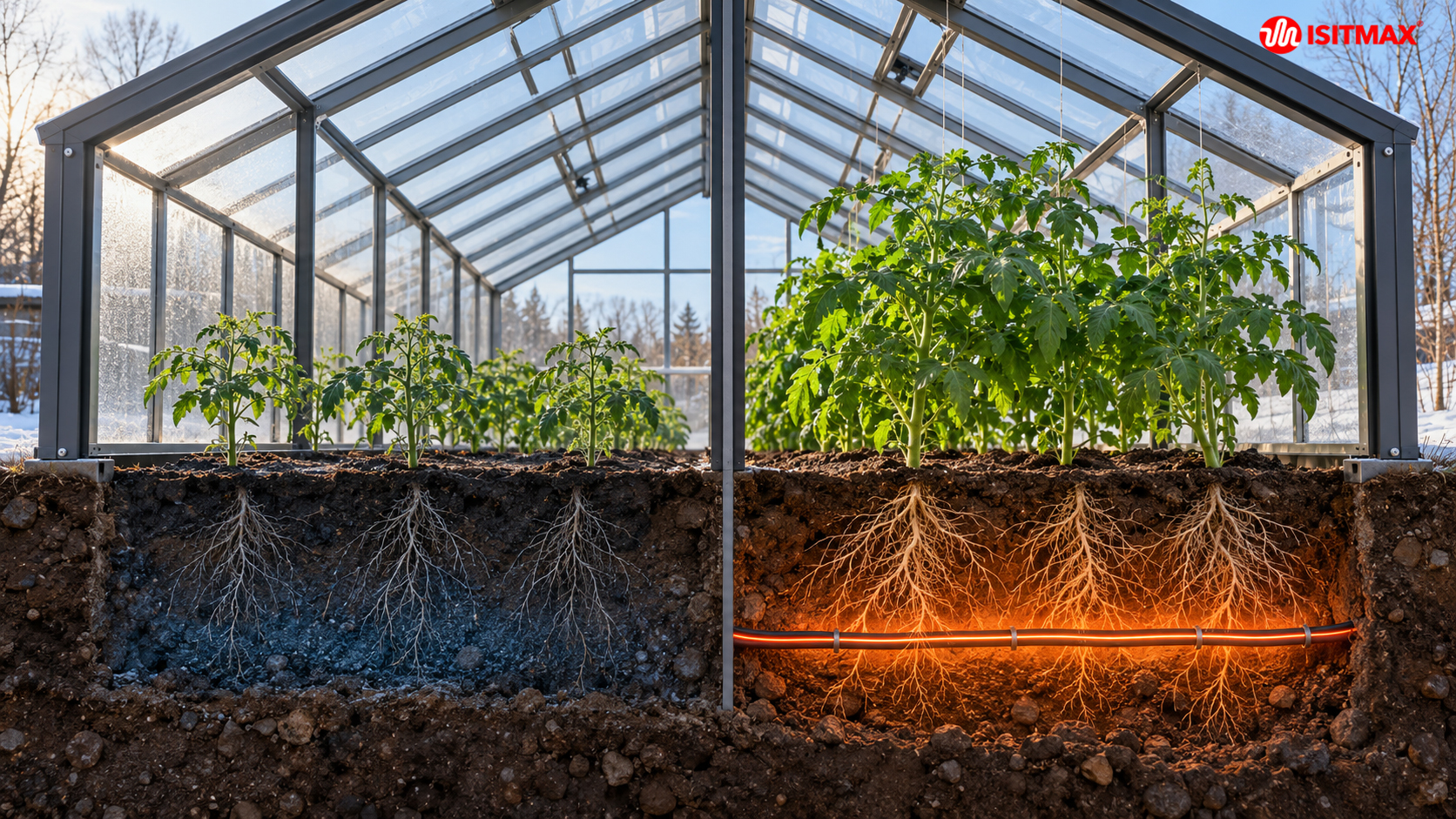
Greenhouse research highlights that root-zone temperature is more decisive than leaf temperature for good plant growth. When the roots are kept at a suitable temperature, the plant takes up water and nutrients more steadily, and growth continues more reliably in cold periods.
-
Water uptake
When the root-zone temperature falls below the suitable range, the roots take up less water.
-
Nutrient uptake
A cold root zone can reduce the uptake of nutrients such as nitrogen, magnesium, manganese and zinc.
-
Lower air temperature
With the root zone kept at a suitable temperature, the greenhouse air can be kept somewhat cooler, which reduces heat loss.
-
Heat where it is needed
Heat goes directly to the zone where the plant grows instead of the whole greenhouse volume.
How does ground-source root-zone heating work?
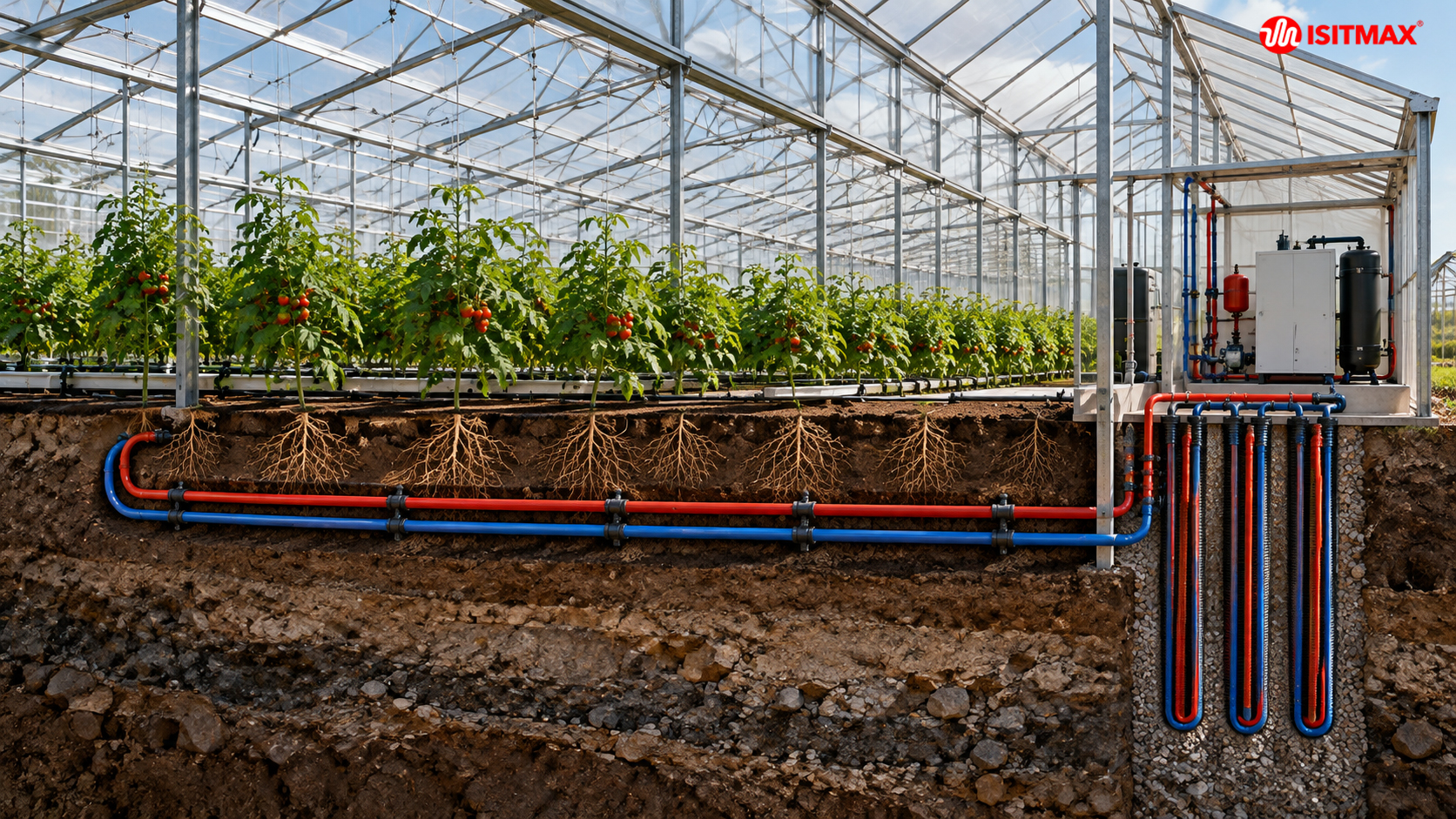
The aim is to use the heat found at a certain depth in the ground, which changes very little with the seasons. The heat exchangers, circulation pump and pipes below the roots work as one closed circuit.
- 1
Root zone
The real target that is heated or cooled: the soil where the plant’s roots are.
- 2
Plastic pipes below the roots
Plastic pipes are laid 30–40 cm below the surface, beneath the root zone, and release the heat they carry into the soil around the roots.
- 3
Circulation pump
The water is kept circulating in a closed circuit by a circulation pump. The root-zone temperature is monitored by a sensor; the pump and circuits run according to the project scenario.
- 4
Deep ground heat exchangers
Heat exchangers buried deep in the ground transfer the heat stored in the soil, which changes very little with the seasons, to the water in the circuit.
Why is the temperature stable deep in the ground?
The soil surface warms in the sun during the day and cools at night, and it goes through large temperature differences across the seasons. These changes weaken quickly as depth increases. Deep enough, the soil temperature stays almost constant all year and approaches the region’s average annual air temperature.
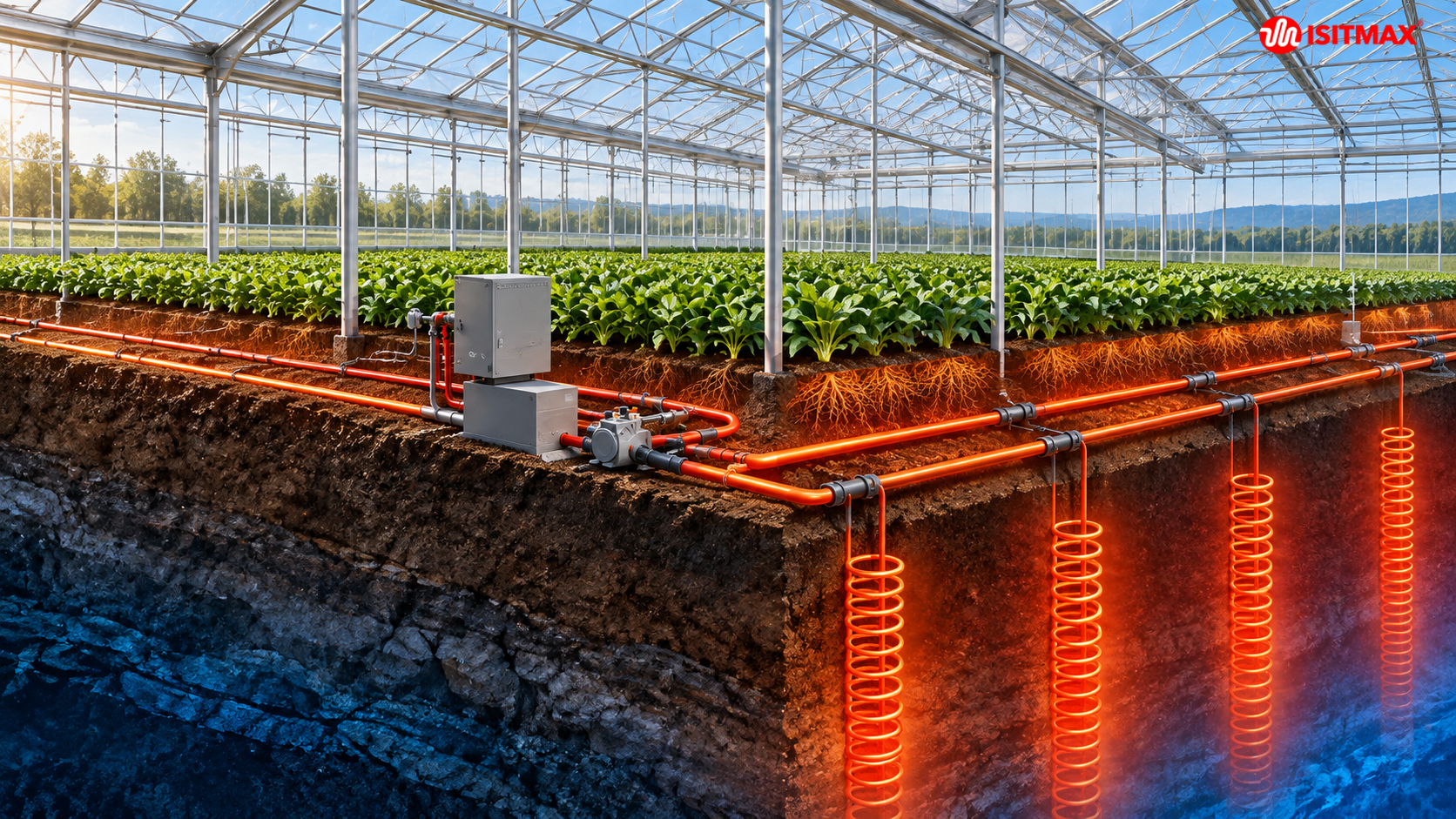
The deep ground therefore behaves like a heat source that is warmer than the surface in winter and cooler in summer. Ground-source root-zone heating takes this stable heat with heat exchangers and carries it to the root zone.
The depth and layout of the heat exchangers are determined at the design stage according to the ground structure, the local climate and the needs of the greenhouse.
Illustrative drawing: the year-round temperature swing decreases with depth.
Advantages of ground-source root-zone heating
-
Savings in heating and cooling
In Agroteknik installations, savings of up to 40–50% are achieved in heating and cooling.*
-
Stable ground heat
The system uses the soil temperature at a certain depth, which changes very little with the seasons.
-
Heating in winter, cooling in summer
The same circuit helps warm the root zone in winter and cool it in summer.
-
Balanced root zone
A more even temperature is created in the soil where the roots are.
-
Less load on air heating
Because the root zone is heated, there is less need to raise the greenhouse air to high temperatures.
-
Ready for automation
Sensor and pump control can be connected to the climate control system.
* The savings rate depends on the size and covering of the greenhouse, the local climate, the crop, ground conditions and how the greenhouse is operated. A project-specific assessment is made during the site assessment and design.
Which root-zone heating system for which greenhouse?
The root-zone heating solution is chosen according to the scale of the greenhouse, the growing method and the existing heating system.
Ground-source root-zone heating
Heat exchangers deep in the ground and plastic pipes laid below the roots work in a closed circuit with a circulation pump. The system carries the stable heat of the ground to the root zone and is used for heating in winter and cooling in summer.
Hot-water root-zone heating
Hot water prepared in a boiler or heat pump circulates through pipe lines in the root zone. It is designed together with the greenhouse’s main heating system.
Electric root-zone heating
Heating cables provide targeted heating of the growing area, benches or specific zones. A practical solution for small areas.
Root-zone heating complements greenhouse heating
Root-zone heating delivers heat where the plant needs it most and reduces the load on air heating. However, on the coldest nights it usually cannot cover the greenhouse’s entire heat demand on its own, so it is planned together with the greenhouse’s air heating.
We describe air heating solutions such as hot-water pipe heating, heat pumps, warm-air heaters and energy screens on our Greenhouse Heating Systems page.
See greenhouse heating systemsWhat is decided when a root-zone heating system is designed?
Root-zone heating is not a stand-alone piece of equipment; it is part of the greenhouse’s energy and climate infrastructure. It is designed together with the greenhouse structure, the main heating system and the automation.
Circuits are balanced so that heat is distributed evenly across the greenhouse, and soil moisture is taken into account so that the soil conducts heat well.
The root-zone temperature is monitored by sensors; the pump and circuits are connected to the climate control system and run according to the target values.
Climate control system- 01Crop, growing method and target root-zone temperature
- 02Greenhouse area and local climate conditions
- 03Ground structure and position of the heat exchangers
- 04Pipe depth, spacing and circuit lengths
- 05Circuit layout for even heat distribution across the greenhouse
- 06Choice of circulation pump
- 07Tillage depth and protection of the pipes
- 08Soil moisture for heat conduction
- 09Closed-circuit equipment: expansion tank, air vent, safety valve
- 10Sensors and connection to automation
The root-zone heating process, from site assessment to service
- 1
Site assessment
The greenhouse, crop, ground and existing heating system are examined on site.
- 2
Design
Heat exchanger layout, pipe depth and spacing, circuits and pump are determined.
- 3
Below-ground installation
Our own team lays the heat exchangers and the plastic pipes below the roots.
- 4
Pump, controls and commissioning
The circulation pump and sensors are connected, and the system is tested and commissioned.
- 5
After-sales service
Support and service are provided after handover.
Think about your greenhouse heating as a whole
Frequently asked questions about root-zone heating systems
If your question is not answered here, call us and we will answer it for your project.
What is a root-zone heating system?
Root-zone heating is a heating method that delivers heat directly to the soil where the plant’s roots are, instead of raising the whole greenhouse air to high temperatures. Keeping the root zone at a suitable temperature helps the plant take up water and nutrients more steadily.
How does ground-source root-zone heating work?
Heat exchangers buried deep in the ground transfer the heat stored in the soil, which changes very little with the seasons, to the water in the circuit. The water is circulated in a closed circuit by a circulation pump and releases the heat into the soil around the roots through plastic pipes laid 30–40 cm below the surface, beneath the root zone.
How deep are the pipes laid?
The plastic pipes below the roots are laid about 30–40 cm below the surface, beneath the root zone. The depth and layout of the deep ground heat exchangers are determined at the design stage according to the ground structure, the local climate and the needs of the greenhouse.
How much does ground-source root-zone heating save?
In Agroteknik installations, savings of up to 40–50% are achieved in heating and cooling. The actual rate depends on the size and covering of the greenhouse, the local climate, the crop, ground conditions and how the greenhouse is operated.
Is root-zone heating useful in summer too?
Yes. In a ground-source system, the deep ground is cooler than the surface in summer. Excess heat in the root zone passes into the water in the pipes and is carried down to the cooler ground below, so the same system helps cool the root zone in summer.
Is root-zone heating enough on its own?
Root-zone heating reduces the load on air heating, but on the coldest nights it usually cannot cover the greenhouse’s entire heat demand on its own. It is therefore planned together with the greenhouse’s air heating system.
Which greenhouses is ground-source root-zone heating suitable for?
Because the pipes are laid in the soil below the root zone, it is used especially in commercial greenhouses growing in soil. Suitability for other growing systems is assessed during the site assessment and design.
Which root-zone heating is suitable for small greenhouses?
In small greenhouses, hobby and R&D greenhouses, electric root-zone heating is used. Heating cables provide targeted heating of the growing area, benches or specific zones.
Can root-zone heating be controlled by automation?
Yes. The root-zone temperature is monitored by sensors; the circulation pump and circuits are connected to the climate control system and run according to the set values.
Who installs and services the system?
Agroteknik designs the root-zone heating system, installs the heat exchangers and pipes with its own team and commissions the system. After-sales support and service are provided.
What does the price of a root-zone heating system depend on?
The price depends on the greenhouse area, the crop and growing method, the ground structure, the amount of heat exchangers and pipe, the number of circuits, and the scope of the pump and automation. A project-specific quote is prepared after the site assessment.
Get a root-zone heating quote for your greenhouse
Tell us your greenhouse area, location, crop and existing heating system, and we will assess together whether ground-source root-zone heating suits your greenhouse.