
Container Greenhouse Systems and Controlled Vertical Farming Solutions
Agroteknik container greenhouse systems combine vertical growing racks, LED grow lighting, hydroponic irrigation and fertigation, climate control, sensors and automation infrastructure within a compact and controlled production unit. Each system can be designed according to the crop, required production capacity and operating conditions.
What Is a Container Greenhouse?
A container greenhouse is a controlled-environment farming system in which crop production takes place inside an insulated and controllable container or modular production unit rather than inside a conventional greenhouse structure.
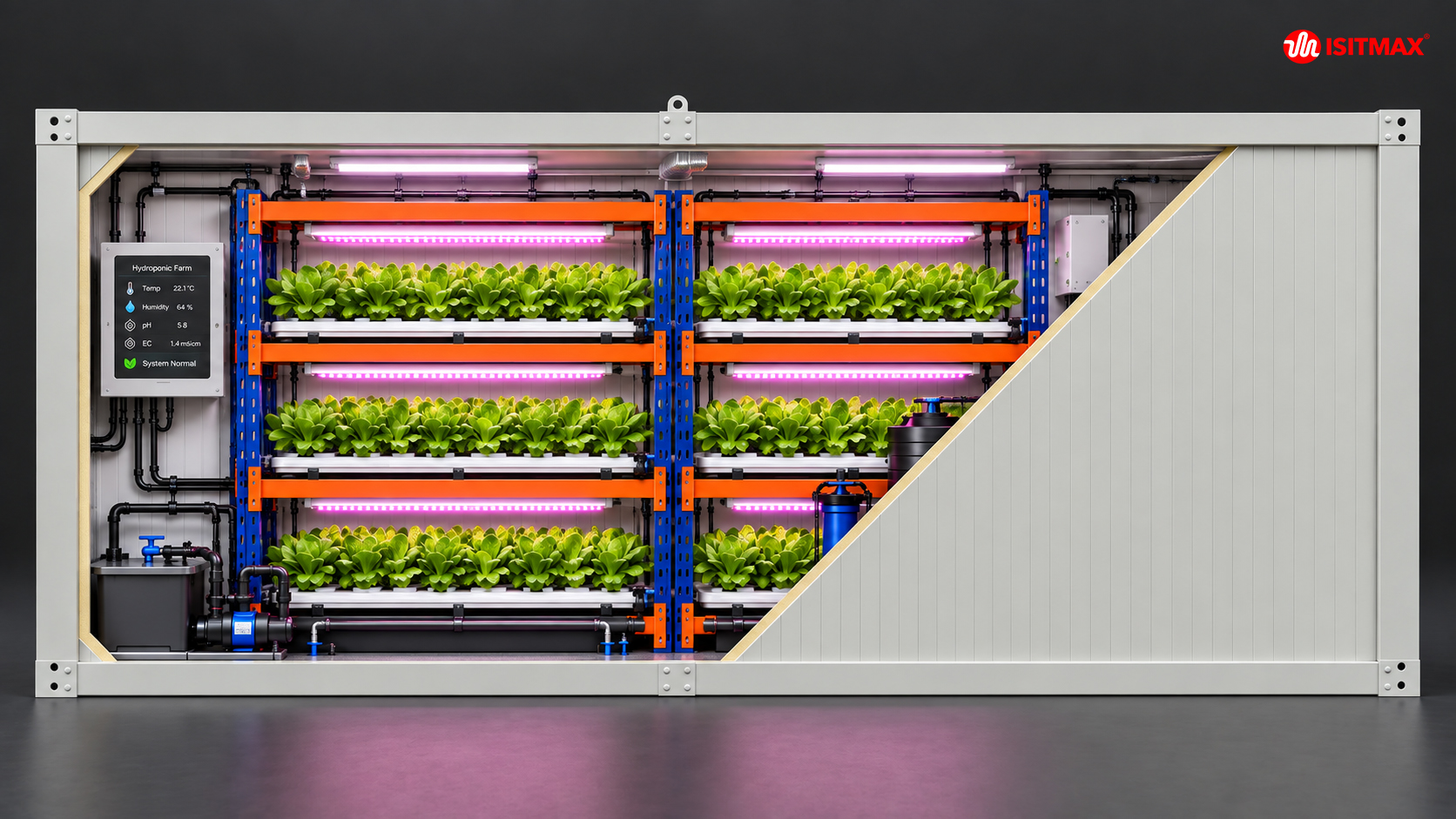
Plants are typically positioned on multi-level vertical growing racks. This allows the available space inside the container to be utilized vertically as well as horizontally, increasing the usable growing area within a compact footprint.
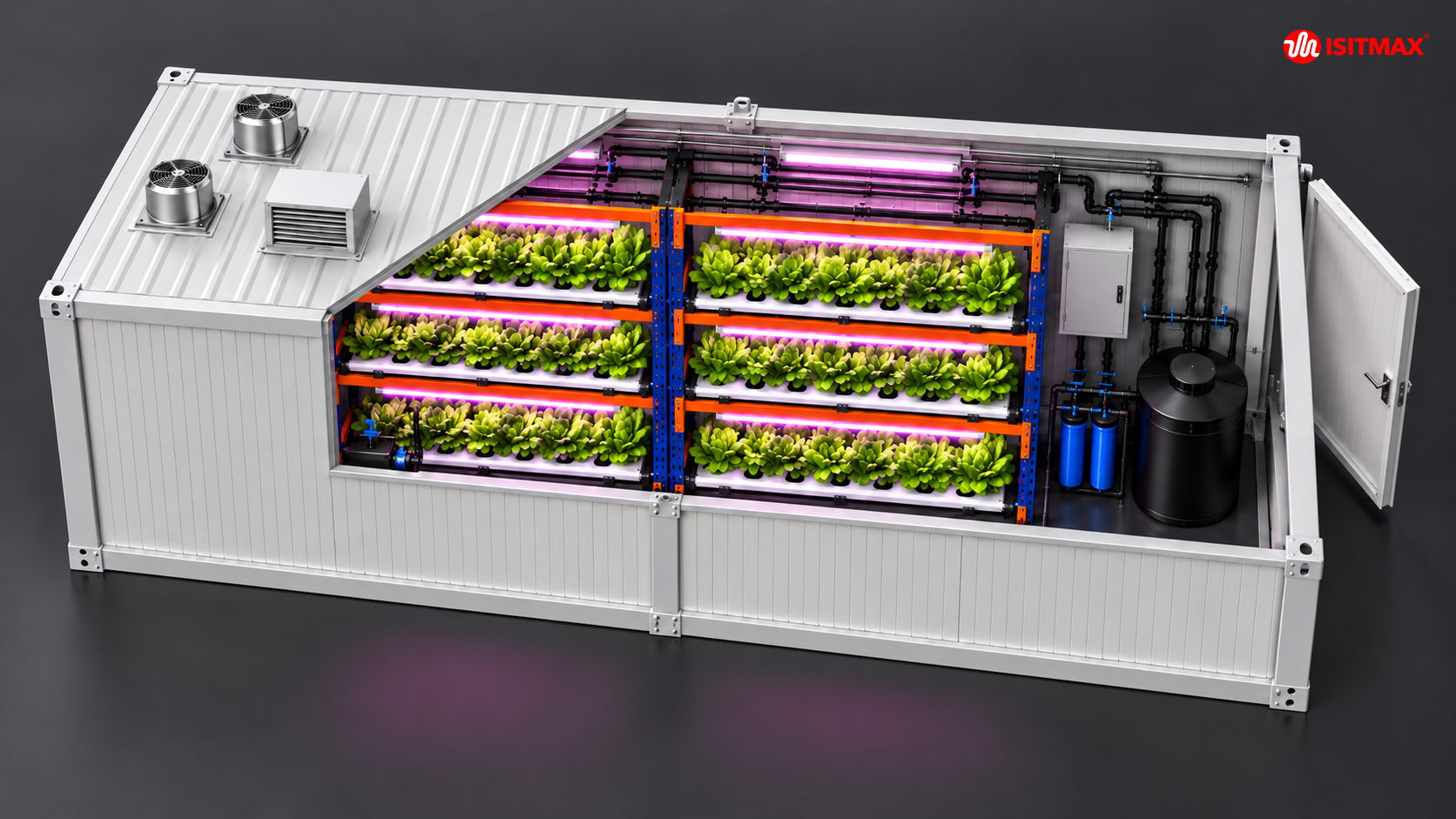
LED grow lights, hydroponic irrigation, fertigation, temperature and humidity control, air circulation, sensors and automation systems operate together to create controlled growing conditions according to crop requirements.
Multi-Level Vertical Growing Racks
Growing racks can be arranged across multiple levels to make more effective use of the limited floor area available inside a container.
The number of levels, rack height, plant spacing and growing channel dimensions are determined according to crop growth characteristics and the required production capacity.
Different growing configurations can be developed for lettuce and other leafy greens, herbs, seedlings and other crops suitable for controlled-environment agriculture.
LED Grow Lighting Systems
Production inside a container can operate independently from natural sunlight through purpose-designed LED grow lights.
Lighting intensity, photoperiod and the distance between fixtures and plants can be configured according to the requirements of the selected crop.
Installing dedicated lighting at each growing level enables the vertical production areas to be managed independently and consistently.
Hydroponic Irrigation and Fertigation
Container farming systems can be designed around hydroponic growing technologies. Nutrient solution is delivered to the root zone through controlled irrigation lines and growing channels.
Water tanks, pumps, filtration equipment, irrigation lines, drainage and fertigation equipment are designed according to the internal production layout.
Important growing parameters such as EC and pH can be monitored using appropriate sensors and control equipment.
Temperature, Humidity and Air Management
Controlling temperature, relative humidity and air movement is one of the fundamental requirements of an enclosed production environment.
Depending on the project, ventilation, circulation fans, heating, cooling, dehumidification and humidification equipment can be integrated into the system.
Climate-control capacity should be calculated according to crop requirements, local outdoor climate conditions and the internal heat load generated by lighting and other equipment.
Core Systems Inside a Container Farm
An efficient container farm consists of more than growing racks. Mechanical, electrical, irrigation and automation systems must operate together as an integrated production infrastructure.
Multi-level modular structures that transform the available container volume into usable growing space.
Controllable lighting designed according to crop requirements and production schedules.
Controlled delivery of water and nutrient solution directly to the plant root zone.
Management of temperature, humidity and air circulation according to production requirements.
Measurement, monitoring and control of environmental and production parameters.
Integration of tanks, pumps, filtration, drainage and electrical infrastructure.
Container Farm Automation and Remote Monitoring
Temperature, humidity, water temperature, pH, EC, irrigation status and other process parameters can be monitored continuously through sensors installed throughout the production unit.
A centralized automation system can manage lighting schedules, irrigation cycles, fans, climate-control equipment and other connected devices according to predefined operating scenarios.
Remote monitoring infrastructure can record production data, generate alarms when values exceed defined limits and support analysis of historical operating conditions.
Agroteknik's automation and data infrastructure approach enables physical agricultural systems to be integrated with sensors, control technologies and agricultural data analytics.
Advantages of Container Greenhouse Systems
Production conditions can be managed with significantly less dependence on outdoor environmental conditions.
Multi-level growing racks transform a compact footprint into several productive growing layers.
Multiple production containers can be installed together as capacity requirements increase.
Irrigation, lighting and climate-control equipment can be integrated into a centralized control system.
Growing conditions can be monitored and recorded through environmental and process sensors.
Production and technical infrastructure can be integrated within a defined and compact area.
Which Crops Can Be Grown in a Container Farm?
The system should be designed according to the physical growth characteristics, root-zone requirements, lighting requirements and production cycle of the selected crop. The same rack spacing, lighting configuration or hydroponic layout is therefore not suitable for every crop.
Container farming is particularly suitable for compact crops that can be efficiently produced under controlled-environment conditions.
What Should Be Considered When Designing a Container Farm?
Container farm design should not be based solely on the number of growing racks that can physically fit inside the structure. Heat generated by grow lights, humidity management, air circulation, electrical demand, water storage capacity, pump selection, drainage and maintenance access must all be evaluated together.
Growing racks and technical equipment should be positioned while maintaining sufficient service and access areas. Filters, pumps, electrical panels, sensors and climate-control equipment should remain accessible for maintenance and operational intervention.
Container insulation and the outdoor temperatures at the installation location also directly affect heating and cooling capacity requirements.
Container Farm Design and Installation Process
The project process begins with production objectives and continues with the integrated design of mechanical, electrical, irrigation and automation infrastructure.
A Modular and Integrated Approach to Controlled Farming
Container greenhouse systems should not necessarily be considered a replacement for conventional greenhouse projects. They represent a compact and highly controlled production model designed for different operational requirements.
Large-scale greenhouse projects benefit from extensive production areas and natural sunlight, while container farming focuses on precise environmental control within a smaller enclosed volume.
Depending on project scale, a single container can operate as an independent production unit, while multiple containers can also be connected to a shared automation and operational infrastructure to create a modular farming facility.
For larger agricultural projects, you can also explore our turnkey greenhouse systems.
Let's Design Your Container Farm Project
Tell us about your planned production capacity, selected crop, number of containers and project location. We can evaluate the vertical growing racks, LED lighting, hydroponic system, climate control and automation infrastructure together.